
9 · Page 74 of 364
How to Behave Around Crocodiles
The habits that keep you alive in crocodile country
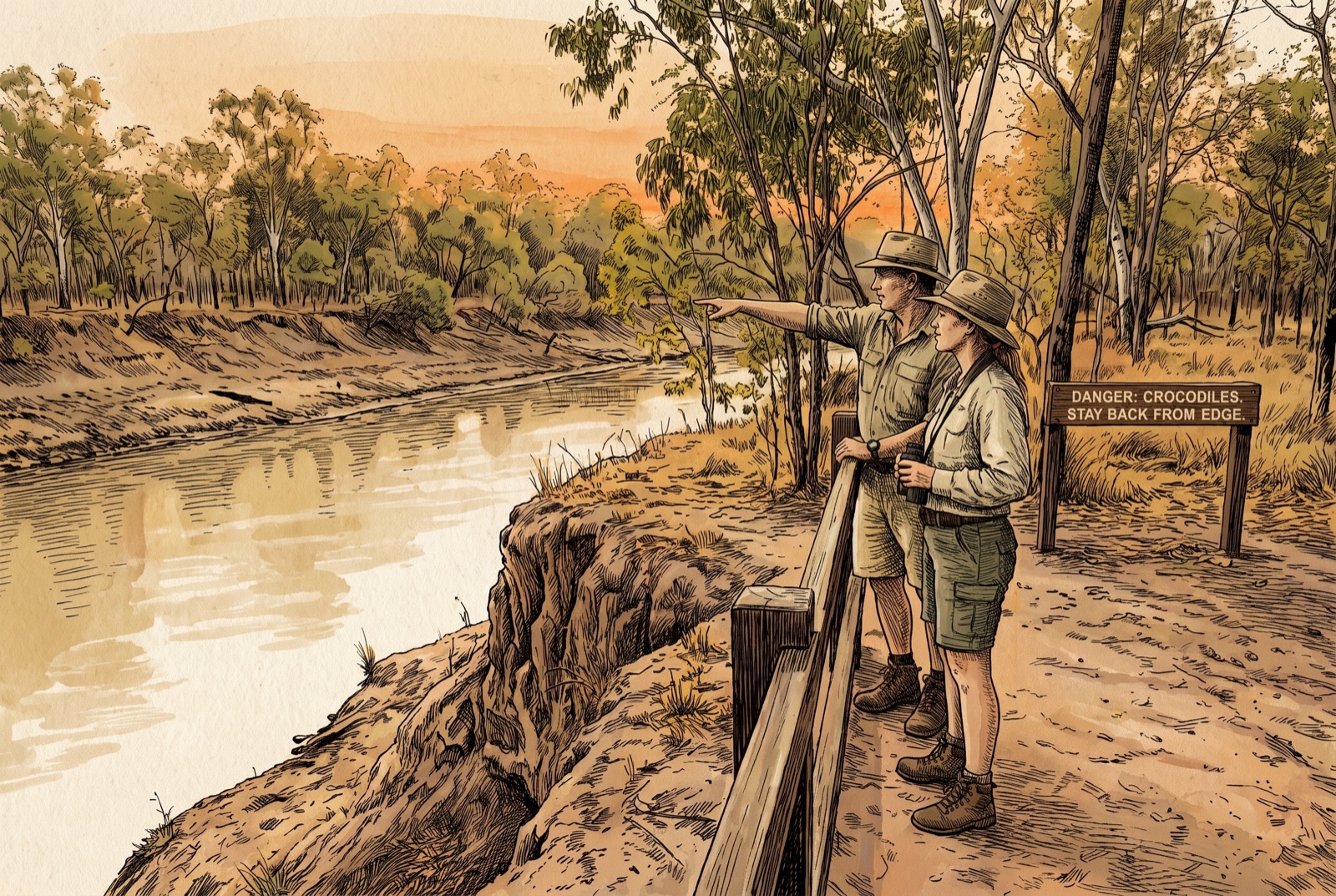
Almost every fatal crocodile attack in the Northern Territory in recent decades has one thing in common: a person entered, or lingered at the very edge of, water that was not a designated safe swimming area. Look across the whole region and the shape holds, even though people meet the water in very different ways. A tourist at a boat ramp, a woman drawing water at a river ghat, a family crossing a flooded ford, a man wading a mine pool for fish. The setting changes; the danger does not. Crocodile safety, stripped to its essentials, is a set of habits about where you put your body in relation to the water. That’s all it is. The habits are the same from Darwin to the Ganges. Learn them until they are automatic, and teach them to everyone you travel with.
The core rules
- Obey the signs. All of them. Crocodile warning signs are not decoration and they are not there for someone else. If a sign says the area is crocodile habitat, believe it completely. The absence of a sign does not mean safety; the presence of one means certainty.
- Only swim in designated, signposted safe swimming areas. This is the behavioural rule everything else rests on. If there is no sign clearly stating the area is safe for swimming, do not enter the water.
- Stay well back from the water’s edge. Most attacks happen at the margin. Keep at least a few metres back from any natural waterway, and never dangle your legs, wade, or crouch at the edge to wash or take a photo.
- Stand back when fishing, and never clean fish or discard scraps near the water. Fishers are over-represented in attack statistics because the sport draws them to the edge, often at dawn or dusk. Cast from well back, never stand on a low bank or log over the water, and never wade.
- Be extra careful at dawn, dusk and night. Crocodiles are most active in low light. Avoid the water’s edge entirely at these times.
- Never rely on “I’ll see it coming.” You will not. The entire hunting strategy of this animal is to be invisible until the instant of the strike.
- Don’t be predictable. If you must use a particular spot near water repeatedly, whether a boat ramp, a campsite tap or a fishing platform, vary your timing and never establish a routine that a watching crocodile can learn.
- Keep pets and animals away from the water. Dogs splashing at the edge are both a target and a lure, and people have died trying to save a pet.
Free preview
Own the whole book — $4.99
You’re reading the free preview of Croc & Gator Wise: The American Edition. 10 more sections are in this chapter — unlock the full field guide to keep reading.
- The complete master — both the American and Australian editions
- Reads on any device · adds to your home screen like an app
- One-time purchase · lifetime access
A Citadel Culebra field safety guide · Vivarium Culebra LLC