
18 · Page 150 of 364
Managing the Crocodile
Trapping, the culling debate, and living with success
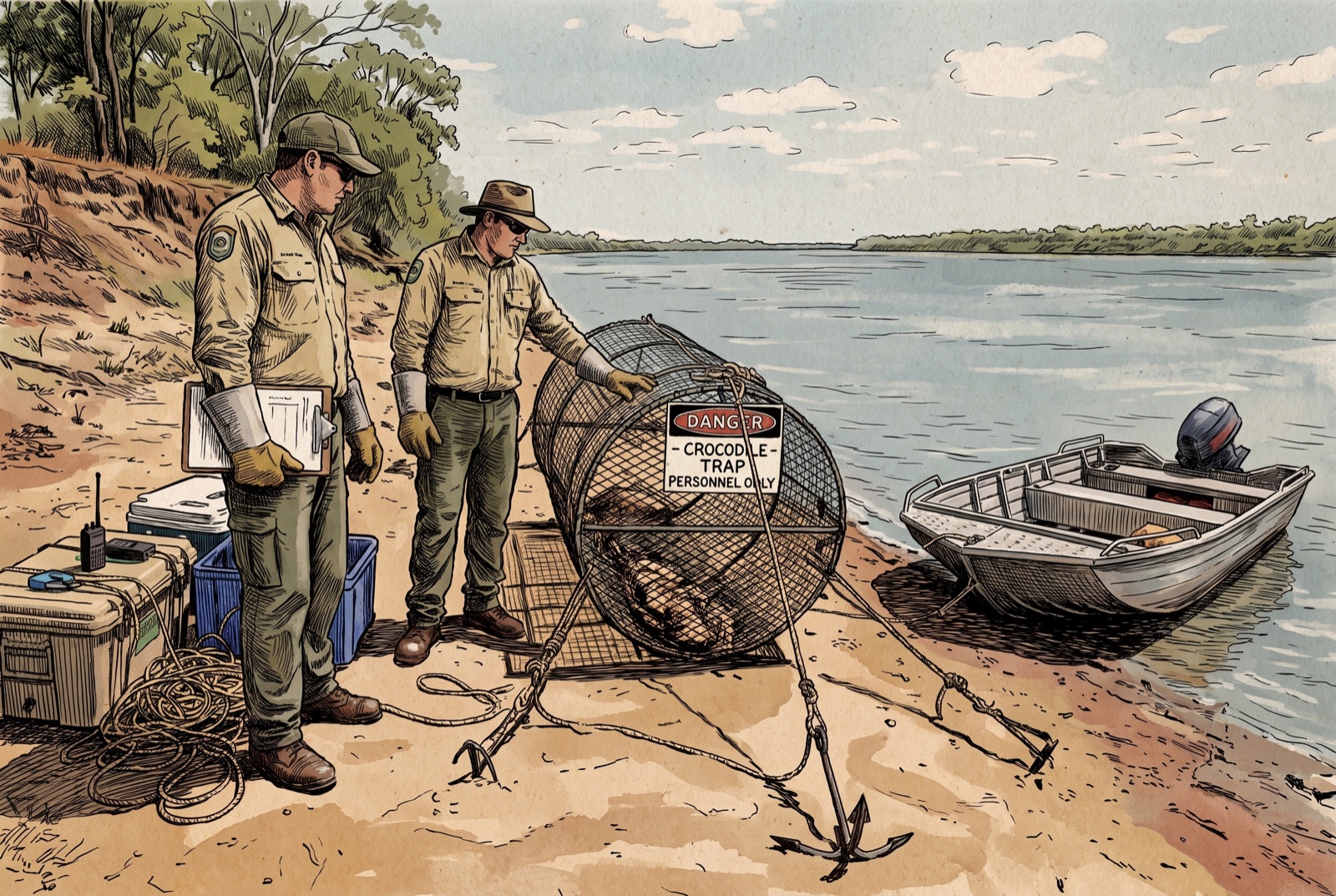
The recovery of the saltwater crocodile created a genuine and difficult question, one the Top End now lives with every day: how do you share a growing region with a recovering population of large, dangerous predators? Australia has answered it with science and a permanent, well-funded management program, and that answer is worth understanding in full. But it is a wealthy country’s answer. Across the rest of the crocodile’s range the same question gets asked with almost none of the same resources, and what comes back looks very different, from India’s crowded rivers to the skin farms of Indonesia and New Guinea. We start with the Australian model because it is the most developed. Then we follow the question out to where it gets hard.
Active management
The Parks and Wildlife Commission of the Northern Territory runs an active crocodile-management program, particularly around Darwin and other populated areas. Rangers survey waterways, set traps, and remove nuisance crocodiles, and more than two hundred and fifty are taken from Darwin Harbour in an average year. This is the work that makes designated swimming areas as safe as they can be, and it is why a managed, signposted site carries an assurance that a random stretch of river never can. But removal is continuous by necessity: take a crocodile out of productive habitat and, sooner or later, and especially each wet season, another moves in to fill the space. Management is a permanent commitment, not a one-time clearing. It never ends. And when an animal does have to come out, killing it should be the last option, not the first. A large nuisance crocodile can often go to a croc farm, a sanctuary or a wildlife park instead, where it lives out its life and, if it is a big breeder, even earns its keep for the species. Releasing one back into the wild somewhere else rarely works, because crocodiles home their way back, as we come to later. But moving one into managed captivity is a real alternative to a bullet, and a croc-wise public should push for it every time it is on the table.
Free preview
Own the whole book — $4.99
You’re reading the free preview of Croc & Gator Wise: The American Edition. 12 more sections are in this chapter — unlock the full field guide to keep reading.
- The complete master — both the American and Australian editions
- Reads on any device · adds to your home screen like an app
- One-time purchase · lifetime access
A Citadel Culebra field safety guide · Vivarium Culebra LLC