
24 · Page 207 of 219
Where They Are: A Range Guide to the Americas
Region by region, state by state, so you can check your own back yard
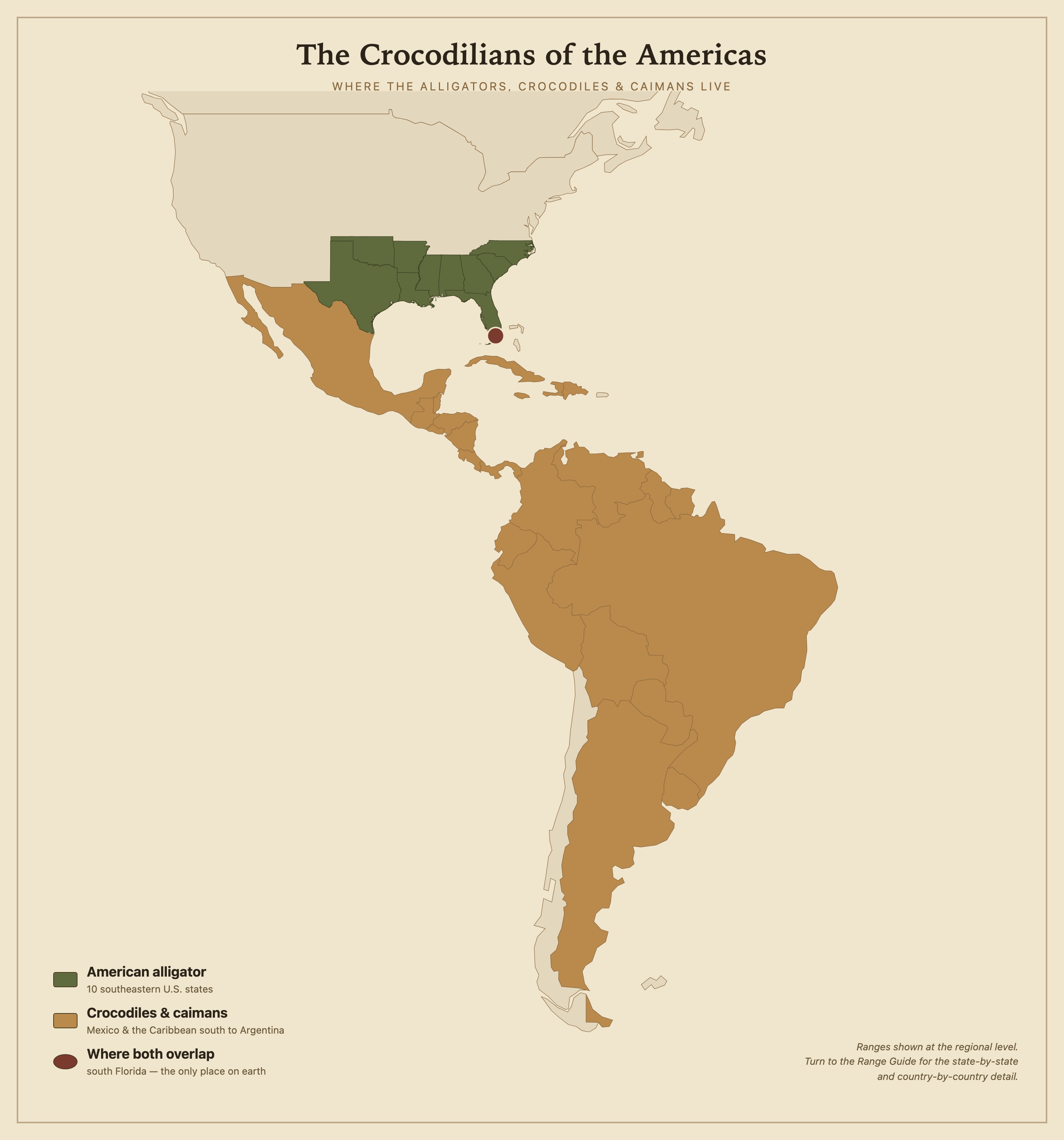
Use this section the way you would a map. It lays out, as plainly as we can, where the crocodilians of the Americas actually live, right down to the state and, where it helps, the corner of the state. The illustrated range map that comes with it shows the same thing at a glance. The point is simple. Before you get in, near, or on the water anywhere, you should be able to answer one question: is this crocodilian country? Here is how.
The American alligator, state by state
The alligator lives in ten southeastern states, and its range has a hard edge set by cold to the north and by dryness to the west. Ten states. Here is where it is, state by state, and where it is not.
- Florida: the whole state. All sixty-seven counties, in fresh and brackish water of every kind, from the Panhandle to the Keys. If it holds water in Florida, treat it as gator water. Florida and Louisiana hold the two largest populations on earth.
- Louisiana: statewide, and densest of all in the coastal marshes of the south. Somewhere around two million alligators, more than any other state.
- Texas: the eastern third, roughly east of a line through Dallas and San Antonio. The Gulf coast, the Piney Woods and the eastern river bottoms are full of them. The Hill Country, West Texas and the Panhandle are not gator country.
- Georgia: the southern half, below the fall line (south of a line through Columbus, Macon and Augusta), and all along the coast. The mountains and upper Piedmont are outside the range.
- Alabama: the southern half, the coastal plain, and the Mobile-Tensaw Delta above all. Rare to absent up in the northern hill country.
- Mississippi: statewide in suitable water, concentrated in the south, along the coast, and through the big river systems.
- South Carolina: the coastal plain and the Lowcountry, roughly the lower half of the state below the fall line. Not the Upstate.
- North Carolina: the far southeastern coastal counties only. This is the cold northern limit of the whole species, so numbers thin out fast as you go north, and you will not find them in the Piedmont or the mountains.
- Arkansas: the southern and eastern parts: the Gulf coastal plain in the south and the Mississippi Delta lowlands in the east. Not the Ozarks or the northwest.
- Oklahoma: the far southeastern corner only, mainly McCurtain County and the Red and Little River bottoms near the Texas and Arkansas lines. The rest of the state has none.
The short version: from the Carolinas down and around the Gulf to eastern Texas, near fresh or brackish water, assume alligator. West of central Texas, up into the hills, and north of the coastal plain, you are out of their range.
The American crocodile
In the United States the American crocodile lives in one place only: the southern tip of Florida. One corner. The Everglades, Florida Bay, Biscayne Bay, the mangrove coasts of the southwest, and the Florida Keys are its US range, and as it recovers it is edging slowly north up both coasts, toward the Tampa area on the Gulf side and Palm Beach on the Atlantic. South Florida is the single place on earth where wild crocodiles and alligators share the same water. From Florida the species ranges far more widely south: both coasts of Mexico, the length of Central America through Belize, Guatemala, Honduras, El Salvador, Nicaragua, Costa Rica and Panama, the Caribbean islands (Cuba, Jamaica, and Hispaniola, shared by the Dominican Republic and Haiti, including the hypersaline Lago Enriquillo), and the northern coasts of South America as far as northwestern Peru and Venezuela.
Morelet’s, Cuban and Orinoco crocodiles
Morelet’s crocodile holds the Atlantic and Caribbean freshwater lowlands of Mexico’s Gulf states, the Yucatán, Belize and northern Guatemala. The Cuban crocodile survives in the wild only in Cuba’s Zapata Swamp and a reintroduced population on the Isla de la Juventud, the smallest range of any crocodile alive. The Orinoco crocodile is confined to the Orinoco basin shared by Colombia and Venezuela.
The caimans
The spectacled caiman is the most widespread crocodilian in the Americas, ranging from southern Mexico through Central America and across the northern two-thirds of South America; introduced, feral populations also hold on in Puerto Rico and in a small pocket of south Florida. The black caiman rules the Amazon basin across Brazil, the Guianas and the western headwaters. The yacare caiman swarms the Pantanal and the Paraguay-Paraná system. The broad-snouted caiman reaches furthest south, into northern Argentina and Uruguay. The two dwarf caimans, Cuvier’s and Schneider’s, hide in forest streams across the Amazon and Orinoco basins.
Wherever you are, match your surroundings to this list before you trust the water. And when you travel beyond the Americas, remember the two companion editions: Africa for the Nile crocodile, Australasia for the saltwater crocodile and the rest. The animal changes with the map. The rules do not.