5 · Page 19 of 219
The Oldest Relationship
Humans and crocodilians, across deep time
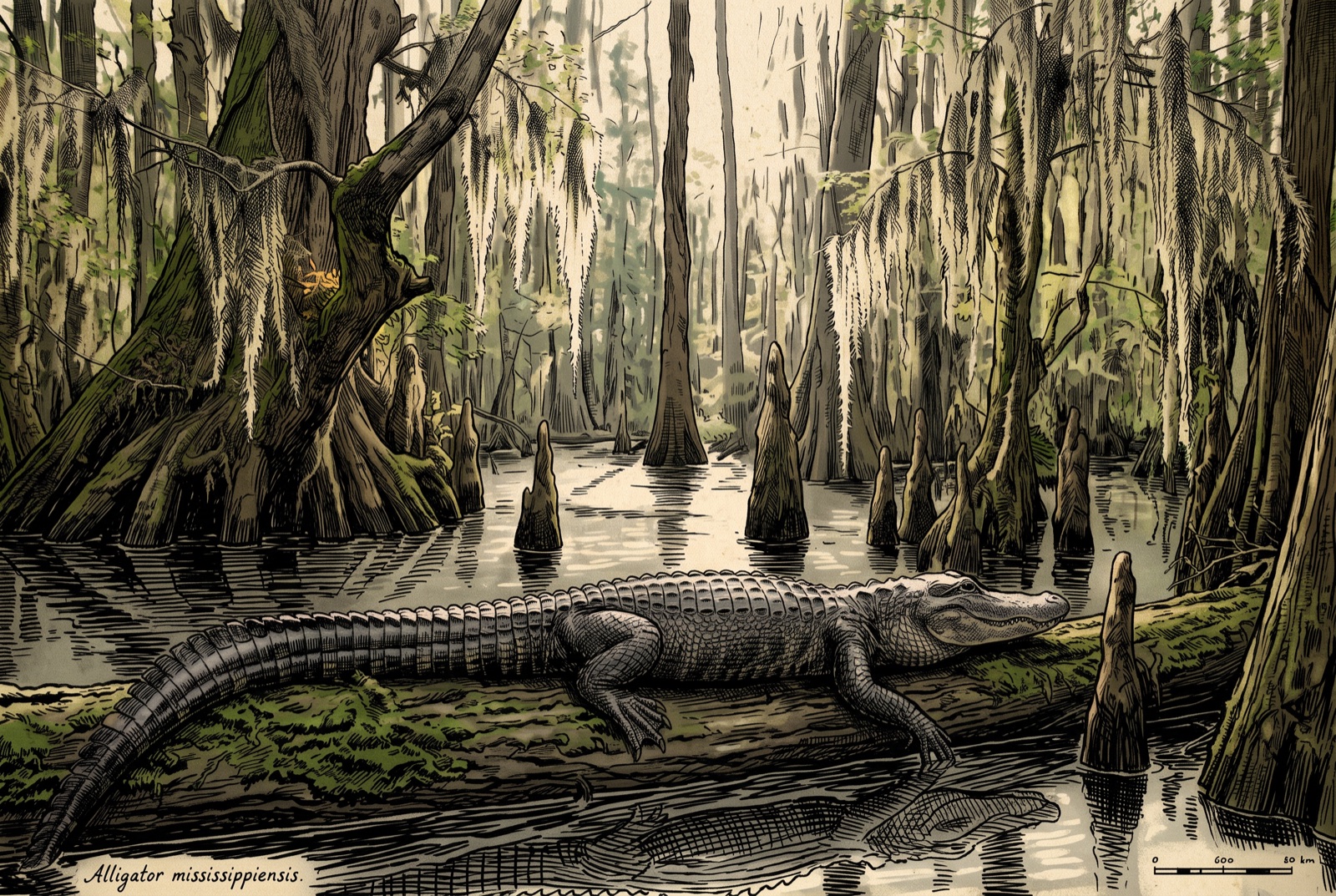
The relationship between people and crocodilians is older than agriculture, older than writing, older than almost anything we would recognize as civilization. For as long as human beings have gathered at the water’s edge to drink, wash, fish and cross, these animals have been there. Waiting. Patient, ancient, and entirely capable of taking one of us. It is one of the oldest and most honest relationships our species has.
Crocodilians are the family that includes crocodiles, alligators and caimans, about two dozen living species in all. When this book says “crocodilian,” it means every one of them, caimans included, not only crocodiles and alligators. Across the Americas that family runs from the American alligator and the American crocodile to Morelet’s crocodile, the rare Cuban and Orinoco crocodiles, and the whole tribe of caimans. The two that share the most water with the most people, and so appear most often in these pages, are the American alligator and the American crocodile; but whenever we say “crocodilians,” the rule we are teaching holds for every one of them, wherever in the Americas you meet it. As a family they have existed in something close to their current form for over eighty million years. They shared the rivers with the dinosaurs and then outlasted them, surviving the mass extinction that ended the age of the great reptiles, then ice ages, then the rise and fall of countless other species. The alligator you might glimpse on a riverbank in the Everglades is the descendant of an unbroken line of survivors stretching back into a world we can barely imagine. People often call them “living dinosaurs.” It is a great phrase, and the awe behind it is earned. It is also wrong. Crocodilians are reptiles: cold-blooded, scaled, egg-laying animals. The dinosaurs were a different group, and the last of them died out some sixty-six million years ago. What is true is that both grew from the same ancient stock, the archosaurs, which makes crocodilians the closest living cousins of the dinosaurs, alongside birds, which actually are dinosaurs. So a crocodilian is not a dinosaur. It is something almost as remarkable: a survivor from that same lost world, still here.
A predator that learned us
What sets the human–crocodilian relationship apart is that crocodilians are one of the very few animals left on earth that still, occasionally, treat a human being as prey. Most large predators have learned over many generations to fear and avoid us. Crocodilians have not entirely done so, and there is a reason for that. They are ambush hunters of opportunity. They do not chase. They wait, submerged and motionless, sometimes for hours, watching the patterns of movement at the water’s edge. When something comes to the same place at the same time often enough, a deer on a game trail, a dog sent to fetch a stick, a person crouching to fill a bucket, the animal learns the pattern and strikes when the moment comes.
This is why crocodilian safety is about behavior rather than watchfulness alone. Watching is not enough. The danger is almost never the animal you can see and keep your eye on; it is the one you cannot see, the one that has already been watching you. You do not stay safe by out-spotting it. You stay safe by never becoming the predictable pattern it is waiting for, and by never walking into its territory unaware it is even there.
Here is the uncomfortable half of it. Most of the time, when a person becomes prey, it is because they stepped into that pattern without respecting the animal that made it. Waded in where they could not see, lingered at the edge at the wrong hour, got into water that was already occupied and never knew it. And there is a bigger, harder version of this on the other side of the world. Where people are desperate, overfishing a river because there is nothing else to eat and stripping out the fish a crocodile lives on, the animal starts to starve, and a starving apex predator takes what is left. That is not the crocodile turning evil. It is hungry. It is us pulling the food out from under it, then acting shocked when it comes looking. The Africa edition gets into that in full. For now, hold onto the honest version: these animals were built to read us, and most of the danger is in how carelessly we hand them the chance.
Reverence, fear, and respect
Human cultures have lived alongside these animals, and revered them, for as long as they have shared the same country. In the American South the alligator runs deep in the story of the land, central to the traditions of Native nations such as the Seminole, Miccosukee, Choctaw and Muscogee (Creek), whose peoples read the water and its animals with a knowledge built over countless generations. Half a world away, the Aboriginal peoples of northern Australia hold the saltwater crocodile, ginga, kinga, as a totemic being woven into creation, law and kinship. The pattern is the same. The lesson is old: people lived safely beside these predators by knowing them. Which waters to avoid in which seasons, how to read the signs on the bank, and passing that knowledge down until it became part of the culture itself.
That is, in a sense, exactly what this book is trying to do in a few short chapters: take knowledge that was once lived and breathed across generations, and hand it to people who did not grow up with it but need it just the same. The newcomer is not stupid. Nobody taught them. This book exists to teach them.
Crocodilians did not become dangerous. They were always dangerous. We are the ones who forgot how to live beside them.