
6 · Page 25 of 219
Know the Animal
The crocodilian family, on its own terms
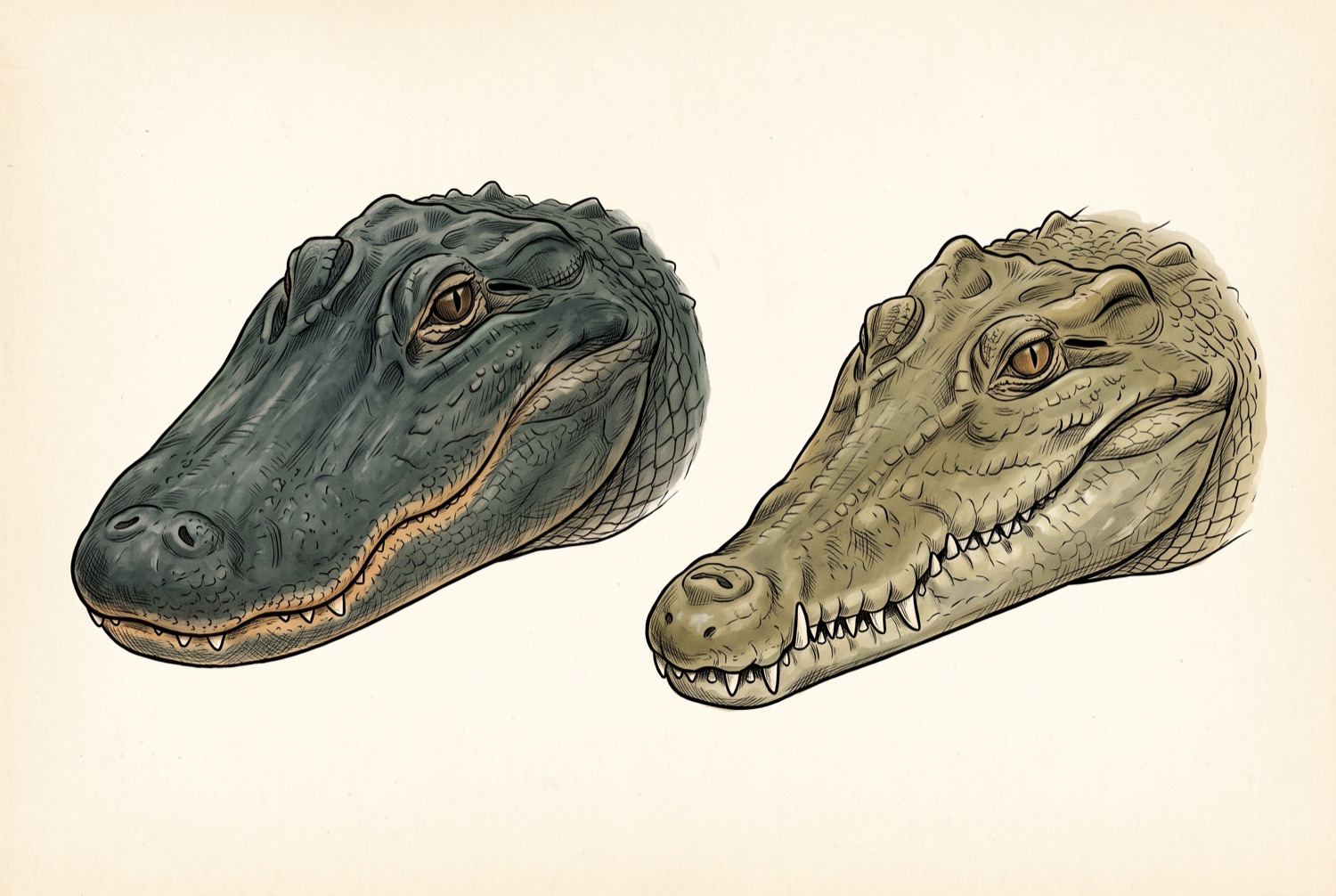
You cannot be genuinely croc-wise, or gator-wise, without a working understanding of the animals themselves. The real ones. Not the cartoon, and not the horror movie. In the United States there are two. The American alligator (Alligator mississippiensis) is the one nearly everyone in the South will actually meet. The American crocodile (Crocodylus acutus) is a coastal species most people never realize lives in the country at all. Those two are only part of a far larger American family that runs south through Mexico and Central America into caiman country, the subject of a later chapter. Neither is the bloated, lazy creature it appears to be when basking: a big alligator can launch itself out of the water faster than a person can react, and over a short distance on land it can move with shocking speed. (The largest crocodilian of all, the saltwater crocodile of Asia and Australia, is bigger still, but that is a story for a later chapter.)
Built for the ambush
- Camouflage and concealment. Crocodilians’ eyes, ears and nostrils sit on top of the head, so they can float almost completely submerged with only an inch or two breaking the surface. Or nothing at all. In murky or shaded water they effectively disappear. And even in the open they are easy to miss: a crocodilian lying still at the surface looks exactly like a floating log, and one resting on the bottom can pass for a rock or a sunken branch. People look straight at them and see nothing, right up until a pair of polarized sunglasses, or a step too close, suddenly resolves the “log” into a nine- or ten-foot animal, sometimes larger. Anywhere these animals live, assume that any log, any shadow, any still shape in or near the water could be one of them.
- Patience. Crocodilians are cold-blooded and can go long periods between meals. Waiting is not a hardship for them; it is their entire strategy. They will watch a productive spot for as long as it takes.
- The strike. The attack is explosive and close-range. An alligator or crocodile does not stalk across open ground; it erupts from the water at the edge, often where prey has come to drink or wade. Most of the danger zone is the first few feet of water and bank.
- The death roll. Once a crocodilian has a grip, it drags its prey into deeper water, and the first thing it does is drown you. The roll people picture mostly comes afterward, once the animal is dead, to twist the body into pieces small enough to swallow, since a crocodilian cannot chew. It will also thrash its head to tear chunks loose. There is no wrestling free once this begins, and it is why the great majority of our safety advice is about the time before contact. We do cover what to try if you are seized, but once you are in the jaws there are no guarantees, only long odds and whatever chance you can make for yourself.
The United States’ two: the American alligator and the American crocodile
North America is home to two crocodilians. Only two. They divide the map. The American alligator is found across ten southeastern states. Down the Atlantic seaboard: North Carolina (the cold northern limit of its range), then South Carolina, Georgia and Florida. Along the Gulf: Alabama, Mississippi, Louisiana and the eastern half of Texas. And inland into Arkansas and the southeastern corner of Oklahoma. From the Carolinas south it lives anywhere there is fresh or brackish water (rivers, lakes, swamps, marshes, bayous, canals and ponds), and Louisiana and Florida hold by far the largest populations. If you are near fresh water anywhere in the Deep South, you are in alligator country.
Far fewer people know the second animal, and that ignorance is dangerous: the United States has a native crocodile. The American crocodile, a coastal, salt-tolerant species quite distinct from the alligator, lives at the very northern tip of its range in south Florida: the Everglades, Florida Bay, Biscayne Bay, the mangrove coasts, and the Florida Keys. As its numbers recover it has even begun turning up farther north, toward Tampa and beyond. From Florida it ranges far more abundantly south, through Mexico, Central America, the Caribbean and into northern South America. And here is the fact almost no one expects: south Florida is the only place on earth where alligators and crocodiles live side by side. Nowhere else. A Floridian standing at the water’s edge could be looking at either one, which is exactly why you need to know both. The next section shows you how to tell them apart. Never let the difference fool you into thinking either is safe. (Mexico and northern Central America hold a third crocodile of note, Morelet’s crocodile of the Gulf and Caribbean lowlands, long dismissed as a small, shy swamp-dweller, though the modern record shows it has injured and killed people, and it earns real respect. The Americas hold others still: the Cuban crocodile of Cuba’s Zapata Swamp, the rare Orinoco crocodile of Venezuela and Colombia, and the caimans of the tropics, from the widespread spectacled caiman to the great black caiman of the Amazon. You will meet them all in a later chapter.)
It isn’t only a swamp thing
Alligators are not confined to wild swamps. Never were. They thrive in the water hazards of golf courses, in retention ponds behind shopping centers, in drainage canals, in neighborhood lakes and backyard ponds. Anywhere warm fresh water sits in the South. “It’s just a subdivision pond” is a dangerous assumption in gator country, and a common one.
How many, and where
By the numbers, the alligator’s recovery is astonishing: somewhere between four and five million now live across those ten states. Louisiana alone holds around two million, more than any other state, and Florida well over a million. Two million. In one state. The American crocodile tells a quieter version of the same story: hunted and squeezed to just a few hundred animals by the 1970s, it has climbed back to roughly two thousand adults in Florida and is slowly reclaiming range it once lost. As American suburbs, golf communities and resort coasts have spread into wetland, more people now live and play closer to large crocodilians than at any time in living memory. Their recovery is something to celebrate, and this book returns to it later, but it also means complacency is no longer an option anywhere in their range.
Crocodile or alligator? Know the difference
Crocodiles and alligators are close cousins in the same ancient order, Crocodilia, a family of around twenty-six living species that also includes the caimans of Latin America and the slender, fish-eating gharial of the Indian subcontinent. Twenty-six. In the end the difference between a crocodile and an alligator is far less important than the one thing they share: every one is an ambush predator of the water’s edge, and the large ones can kill a person. Knowing which you are looking at is useful, and genuinely interesting. It changes nothing about how carefully you treat the water.
The quickest tell is the snout. An alligator’s is broad and rounded, shaped like a U; most crocodiles have a narrower, more tapered snout, closer to a V. With the mouth shut, a crocodile shows a toothy grin, the large fourth tooth of the lower jaw sitting outside the mouth in plain view, while an alligator’s upper jaw hides its lower teeth. Alligators tend to be darker, almost black; crocodiles are often lighter, olive or tan. Learn these tells if you like, but never treat them as a safety test. It does not matter which one you have identified. Both can kill you. Both get exactly the same wide berth, and you would never approach one for a closer look, because getting nearer never makes you any safer.
Two differences run deeper than looks. First, salt. True crocodiles have working salt glands on the tongue that shed excess salt, so they can range far out into salt water: estuaries, mangrove coasts, and even the open sea are all part of their habitat. Alligators and caimans lack those glands, so at heart they are freshwater animals. Do not take that to mean the coast is a gator-free zone, though: American alligators do turn up in coastal marinas, brackish marshes and even out in the surf, especially along the Carolina coast. They simply cannot stay. Without salt glands, saltwater slowly wears them down, so they are only ever passing through, and “rarely” is not “never.” Of the crocodilians a person in the Americas might actually meet, it is really only the American crocodile that is built for the sea; the one other great ocean-goer, the saltwater (or Indo-Pacific) crocodile, lives on the far side of the world. Second, temperament, and here the honest comparison is between our two American animals. Both the American alligator and the American crocodile are, as a rule, wary of people and do not regard us as food. That is genuinely reassuring, and it is exactly what gets people killed, because “it’s only a gator” talks them into the water. The world’s true man-eaters, the saltwater and Nile crocodiles, are wary of people too, right up until they are not. But even they are best understood as opportunists, not hunters with a grudge: a crocodilian does not set out after one particular person; it takes the opportunity that presents itself, and to a big saltwater or Nile crocodile, a person at the water’s edge can simply become that opportunity. An American gator or crocodile is far less likely to see you as a meal. A defensive, territorial, startled, or food-conditioned one will kill you just as dead. Give every crocodilian, whatever its name, a crocodile’s worth of respect.
- Snout: broad U-shape (alligator) versus narrow V-shape (most crocodiles).
- Teeth: alligators hide their lower teeth; crocodiles show a toothy grin with the mouth closed.
- Water: alligators keep to fresh and brackish water; crocodiles range into estuaries, coasts and the open sea.
- Where both live: south Florida is the only place on earth where wild crocodiles and alligators share the same water.
Everywhere else you will meet one or the other. The safe assumption never changes. If it is natural water in crocodilian country, behave as though a large one is in it.