8 · Page 39 of 219
The Umwelt — How a Crocodilian Perceives Its World
Tom Crutchfield’s lesson: understand the animal’s world to live safely in it
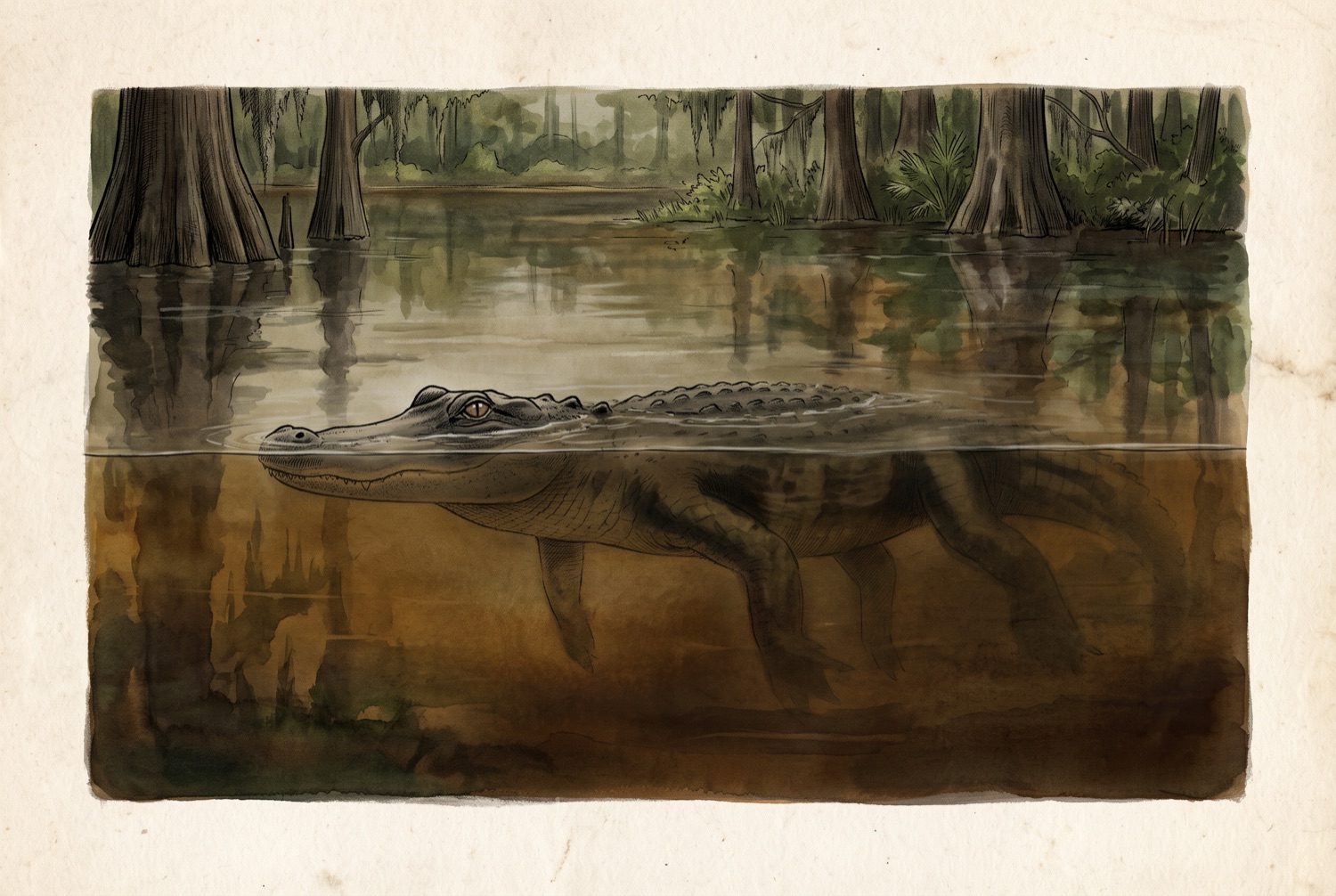
To be truly croc wise, and to genuinely respect this animal, you have to understand what it actually is. Forget the cartoon. Forget the trophy. What you are looking at is a machine: eighty million years of refinement into possibly the most efficient ambush predator that has ever lived. But understanding the animal is not only a matter of anatomy. It is a matter of perception, of learning to sense the water the way the animal senses it. This is the chapter to read slowly, because it holds the idea that everything else in the book rests on.
The umwelt: the world as the animal senses it
There is a German word that Tom Crutchfield comes back to again and again, after a lifetime spent with these animals: umwelt. Coined by the biologist Jakob von Uexküll, it means the world as a particular creature actually perceives it: whatever its own senses build for it, which is never quite the world as it objectively is. Every animal lives inside its own umwelt, and a crocodilian’s is almost nothing like ours. Nothing like it. The one you are dealing with is an apex predator’s: a world built around a single job, detecting and closing on and holding prey. Tom’s central teaching is that you cannot be safe around one of these animals, and you certainly cannot live alongside it, until you stop imagining it experiences the water the way you do, and start understanding the water the way it does.
To a crocodilian, the surface of the water is not a view. It is a sheet of information. It does not need to see you to know you are there. It never did. Studding its skin, packed in their thousands around the jaws, are tiny dome-shaped pressure receptors called integumentary sense organs, each more sensitive than a human fingertip, each wired to the great facial nerve, the trigeminal. Those sensors read the faintest disturbance in the water so finely that the animal knows something living has entered its domain long before it can make out what. A ripple is not noise to it. A ripple is a message, and the animal is already reading it while it is still invisible to you.
What you look like from inside that world
The moment you enter the water, you begin to broadcast. Every splash, every kick, every stroke of a limb near the surface sends out exactly the low, irregular pulse that a struggling, wounded or drowning animal makes, one of the most compelling signals in a crocodilian’s world. Wading carefully does not make you quiet. You are loud. To the animal’s sensors you are ringing a dinner bell. This is why the surface, the shallows and the murk carry more risk than anywhere else: they are precisely where your movements read most loudly as prey. You cannot see the animal, and you assume that means it cannot register you. In its umwelt the opposite is true, and the disturbance you make at the surface is the loudest thing in the water.
This is what Tom most wants people to understand. To a large crocodilian, a person in its water, or at the very edge of it, is only ever one of two things. You are a rival: a foreign body, an intruder, a challenge to the territory it holds and defends. Or you are food. There is no third category in that animal’s umwelt. There is no “harmless tourist,” no “just cooling off,” no “only for a second.” You have walked into a world with two doors, and both of them are bad. Understand that, and the distance this book keeps asking you to keep stops being timidity and becomes simple literacy in the animal’s own language.
This is the lesson Tom returns to more than any other, and it runs underneath every chapter that follows. Being brave will not keep you safe. Neither will being strong, or being lucky. You stay safe by understanding how the animal perceives the world, and then refusing to place yourself in the part of that world where you become a signal worth investigating. The very same understanding is what makes coexistence possible: read the animal’s umwelt correctly and you can share a landscape with it for a lifetime. People do. Whole towns do. Misread it, assume it sees what you see, wants what you would want, fears what you would fear, and sooner or later you will make the one mistake it is built to punish. Everything that comes next in this chapter, all the anatomy and the numbers, is simply the machinery behind that world. Read it as the answer to a single question: how does this animal experience me, and how do I keep from ever becoming something its senses call toward?
Learn to read the water the way the animal reads it. Understand its world, and you will know where you must never be. This is the lesson of Tom Crutchfield’s life with these animals.
Size, length and strength
The two animals a person in the United States is most likely to end up close to, often far closer than they realize, because these animals share the water’s edge with people every day, are the American alligator and the American crocodile, and neither is small. A big bull alligator usually tops out around eleven or twelve feet, which is already an enormous animal; exceptionally large individuals reach thirteen, and the largest ever reliably measured was just under sixteen feet. That is extraordinarily rare. A mature female most often maxes out near eight feet, and though a few grow larger, even that is longer and heavier than the biggest human being alive. The American crocodile runs in the same league: it commonly reaches twelve to fourteen feet, with large old animals matching or beating a big gator. Either species can weigh anywhere from several hundred pounds to half a ton and beyond: muscle, bone and armor built around a single purpose, with a tail powerful enough to drive the whole body clear of the water and break a grown person’s leg with a single sweep. There is no human strength, in the water or out of it, that competes with an animal like that. None. (The largest crocodilian on earth, the saltwater crocodile of Asia and Australia, is larger still, over twenty feet and over a ton, but you do not need a record-breaker to be killed. An ordinary gator will do it.)
The most powerful bite ever measured
Bite force tells the same story. When researchers measured the bite of every living crocodilian species, the numbers were staggering across the board. An American alligator bites at close to 3,000 pounds of force, and the American crocodile is in the same devastating range; the saltwater crocodile, the global record-holder, reached about 3,700 pounds of force, the strongest bite ever measured in any living animal. Any of them. To picture a number like that, think of the weight of a small car bearing down through the jaws. The scientists who ran the study liked to say that if you can bench-press a car, you would be an even match for the bite. For comparison, a lion or a tiger bites at roughly 1,000 pounds of force, and a human at well under 200. What that means for you is simple: any adult crocodilian bites with many times the force needed to snap bone, and once those jaws are shut there is no prying them open by strength.
What 3,700 pounds of force means for you
Enough force to crush bone and shear through almost anything the jaws close on. The muscles that snap them shut are immensely strong. Once they have you, they do not let go.
The strike, the speed, and the death roll
The attack is explosive. From a dead-still float, an alligator or crocodile can launch its entire body out of the water in a single upward surge, powered by that enormous tail, fast enough that there is no flinching out of the way once it commits. And in the water it is more dangerous still: a big crocodilian swims at close to twenty miles an hour. You will not out-swim one. People have tried. The water is its element, and the contest is over before it begins.
Once it has a grip, it does what crocodilians have always done to their prey: it drags the catch into deeper water and drowns it. Only after that comes the roll people picture, the whole body spinning to twist a dead animal into pieces small enough to swallow, since a crocodilian cannot chew. The drowning is first. The spin is not how it subdues you; it is how it butchers what it has already killed. Being pulled into deep water in the jaws of an animal that size is a desperate position, and the odds of getting out of it are very low, though not zero. People have fought free, most often in the split second the animal shifts its grip. But once a big crocodilian has taken you under, your chances narrow to almost nothing. That is one of the hardest truths in this book, and the reason the great majority of our advice is about the time before contact, the one moment you can still control.
The odds of fighting free of a crocodilian’s grip are slim to none. Your safety lies in never becoming something one can reach.
It does not have to be a giant
A misunderstanding gets people killed here, and it needs saying plainly: a crocodilian does not have to be huge to kill you. People picture the monster sixteen-foot animal and assume anything smaller is harmless. That is fatally wrong.
A crocodilian of around six feet is entirely capable of killing and taking a child, and can badly hurt or even kill an adult. At eight feet you might fight your way clear, but it would be a savage, desperate encounter and you would be lucky to. As the animal gets bigger your odds fall away fast: against a ten- or twelve-footer an adult is almost certainly not winning, though even then people have, against all odds, survived. Even a much smaller sub-adult has been recorded killing prey heavier than itself. Most people get the next part wrong. They picture the giant sixteen-foot monster, but the animals most likely to turn up where people are, at least here in the Americas, tend to run in the eight-to-ten-foot range, often not yet big enough to hold their own territory against the dominant males. Pushed out, they wander. They move through high water after heavy rain and search out new water in dry spells, which is exactly how a dangerous animal ends up in a canal, a pond or a backyard where no one expected one. People write these wandering, sub-dominant animals off as harmless small fry. They are the ones you are most likely to meet.
Never measure danger by size
A six-foot crocodilian can kill a person, and can take a child. An eight-foot animal can take an adult, though you might fight clear of one that size in a brutal encounter. A ten-foot crocodilian will take an adult out. The ones that wander into populated areas are often the very animals still searching for territory. Small is not safe. Treat every crocodilian, of every size, as lethal.
The last resort is not a plan
You may have heard that a crocodilian’s jaws are easy to hold shut, or that going for the eyes will make one let go. Both need unpacking. It is true that the muscles that open a crocodilian’s jaws are far weaker than the enormous muscles that close them, but that helps a trained person holding a captured animal’s mouth shut from the outside, not someone already caught in its grip. If you are ever seized, do not do the instinctive thing and rip the trapped limb straight back; you will not overpower the grip, and hauling against those inward-curved teeth tears flesh and can make the wound catastrophically worse. Your best chances lie elsewhere. If the animal repositions its bite, and they often do, adjusting for a better hold, that split second is your one real opening to pull free. Failing that, go for the eyes: they are the one soft, sensitive spot on the animal, and driving a thumb or fingers into them as hard as you physically can may buy a moment of confusion and discomfort in which the mouth opens. None of this is a guarantee. These are animals that survive being shot, and a finger in the eye is a best chance, not a sure thing. This section is not a fighting manual. It is proof of how bad the position is. This entire book exists so that you are never in it. If you ever have to use any of this, mistakes were already made.
The fishers at the water’s edge
A large alligator or crocodile can lie invisible in ten inches of murky water, strike explosively from the edge, seize you in a grip you cannot break, and take you under faster than anyone on the bank can move. Ankle-deep is within range. “For a second” is all it takes. People have waded after a lure, stood in the shallows to cast, or stepped in to land a fish, and were killed doing it. And there is a second fisher’s mistake that is just as deadly: tossing fish scraps, guts, or bait into the water. It does exactly one thing: it teaches the local predators that people mean food, and draws them straight to where you are standing. Never clean your catch or dump scraps at the water’s edge.
Understand the animal, and the rules stop feeling like restrictions and start feeling like simple sense. This is the ultimate ambush predator: invisible, patient, armored, impossibly strong, and indifferent to your plans. Indifferent, not malicious. You respect a creature like that by keeping your distance, and having understood it, you cannot help but find it magnificent.
The perfect ambush predator gives no warning and no second chance. Awe it from a distance. Stay out of the water.
Senses built to find you in the dark
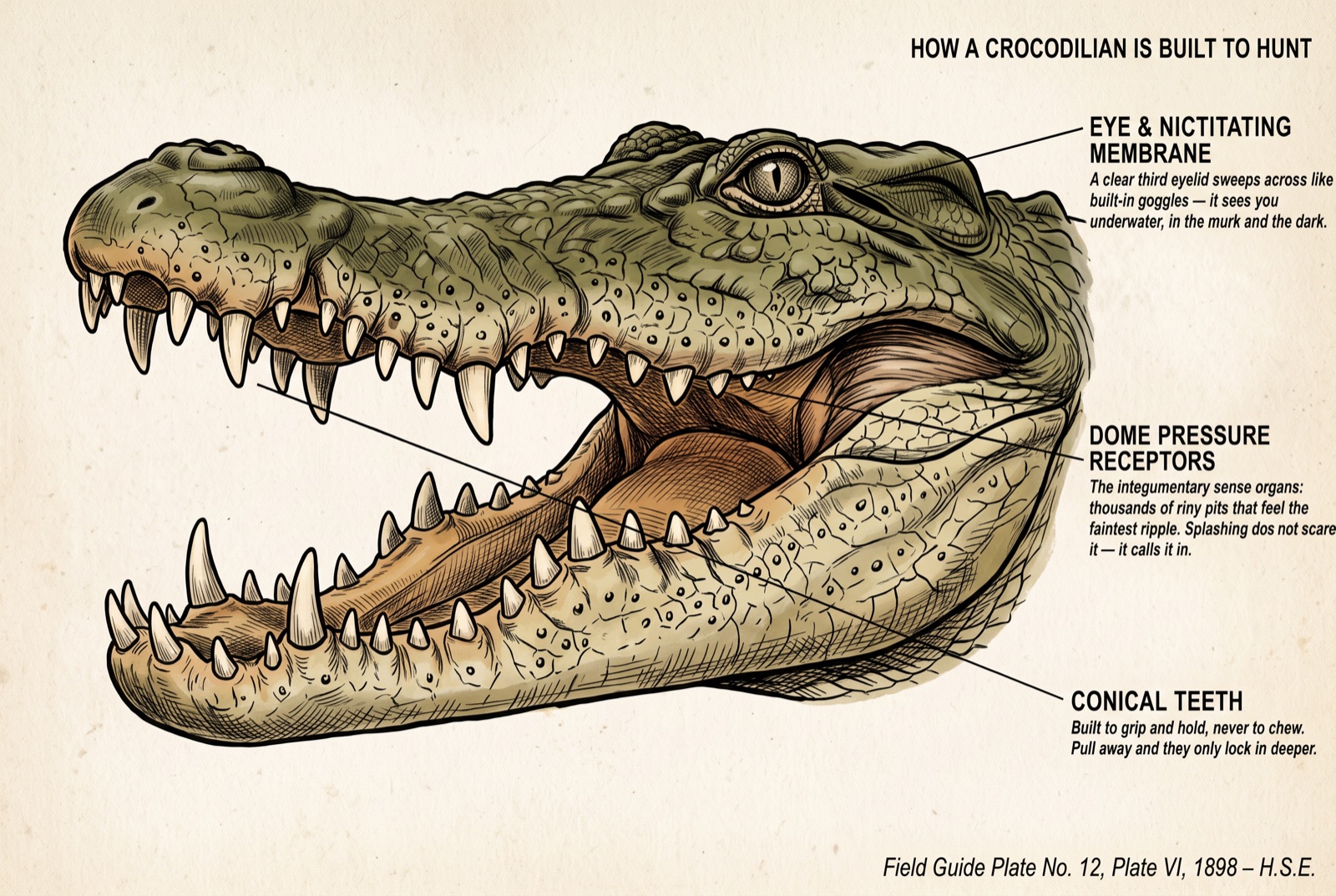
You already met the animal’s most important sense: those integumentary sense organs, the dome receptors packed around the jaws and, on a crocodile, scattered across the whole body, reading the faintest disturbance in the water. They are only part of the kit. Not even half. Add the nictitating membrane, a clear third eyelid that sweeps sideways across the eye like built-in goggles and lets the animal see underwater in murk and darkness while the eye stays protected. Add sharp hearing, and eyes and nostrils set on top of the head so it can lie all but submerged and still watch you and breathe. Put it together and you have a hunter that has already found you while it is still invisible to you. That is why splashing, murk and darkness are no protection at all. They are the exact conditions these animals were built for.
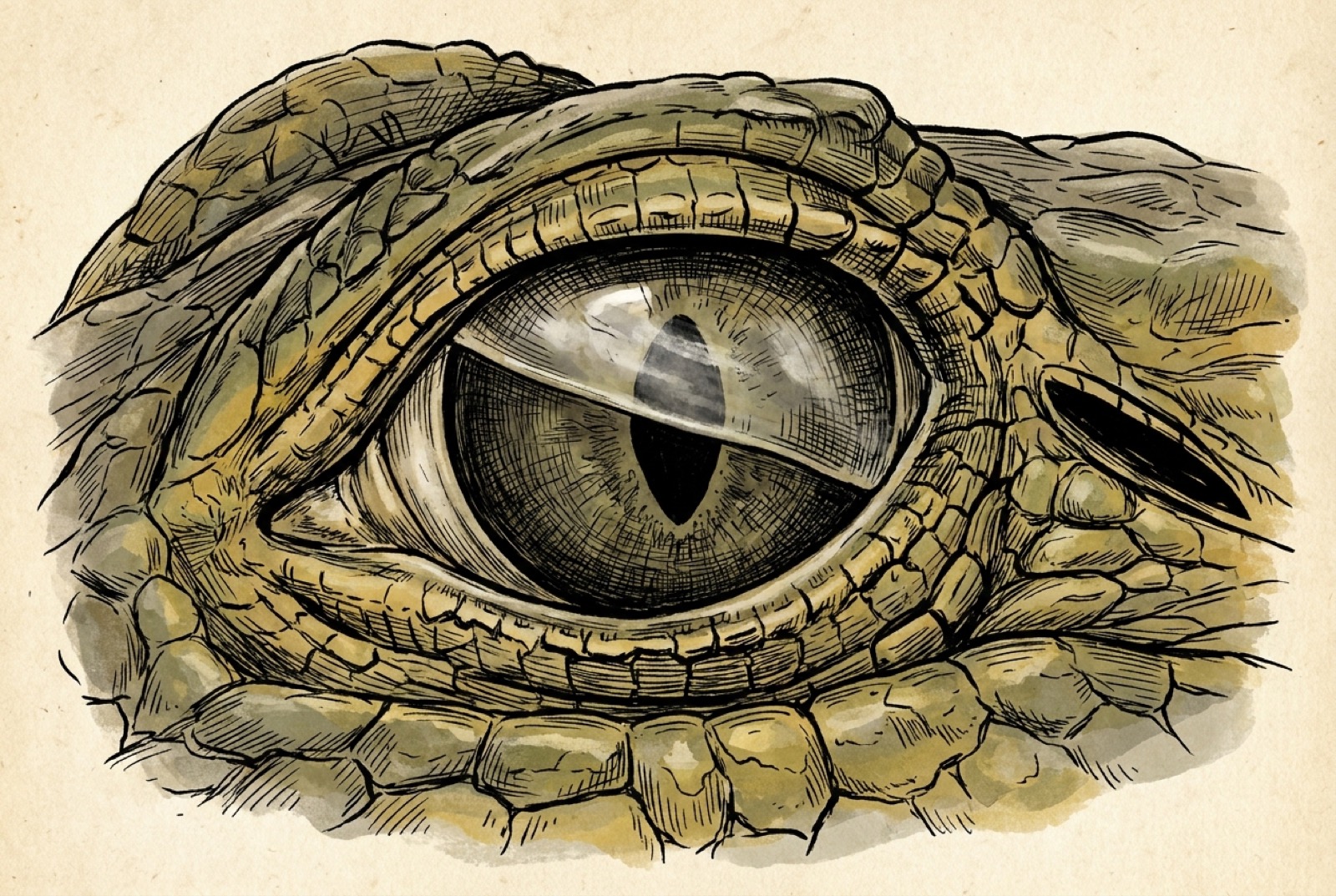
Built to take punishment
Beneath the skin of a crocodilian lies a suit of armor: bony plates called osteoderms, mineralized with the same substance as our own bones and interlocked to spread the force of a blow. Real armor. Above it runs an immune system so powerful that these animals routinely survive catastrophic wounds and lost limbs in filthy, bacteria-laden water that would kill almost anything else; their blood carries antimicrobial compounds that science studies for our own medicine. They can slow the heart to two or three beats a minute and hold their breath for fifteen or twenty minutes as a matter of course, longer than an hour at rest, and hours in cold water. Their lineage has been on this planet for more than two hundred million years and walked away from the extinction that erased the dinosaurs. Pound for pound, they are among the hardest animals ever to live, and nothing you can do in the water will out-tough one.
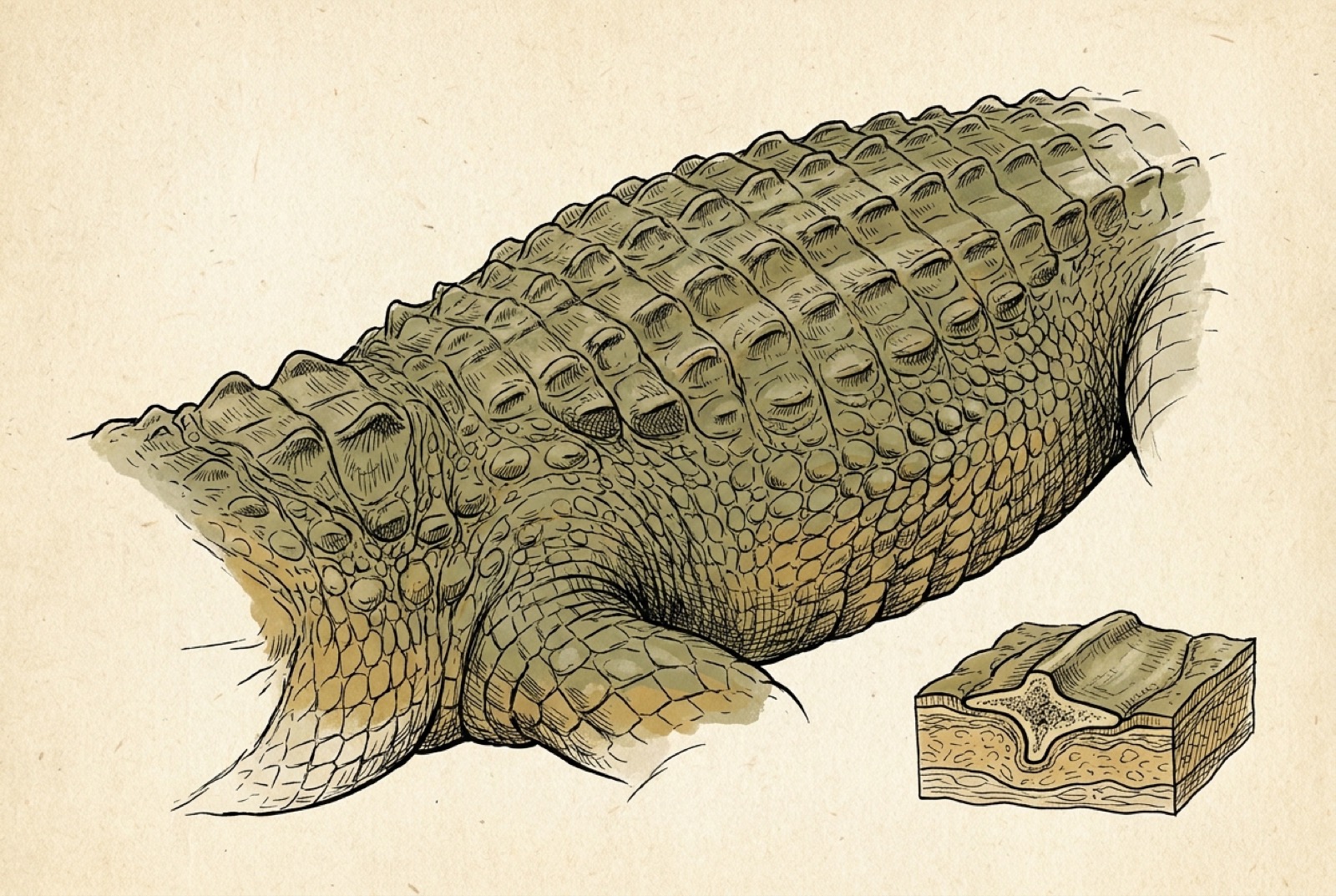
Tail, skull and teeth: the machinery of a kill
Every part of a large crocodilian is built to end a struggle fast. The tail is a muscular club heavy enough to knock a grown adult off their feet. A sideways thrash of the head carries enough force to shatter bone. And the jaws close with staggering power: an American alligator and an American crocodile at nearly three thousand pounds of force, ranging all the way up to the big saltwater crocodiles of Asia and Australia at close to four thousand, many times the strength of a lion. But the bite’s real genius is its teeth: conical pegs built to grip and to hold. Once they are set, they cannot be pulled loose, and the harder you pull away the deeper they seat. So do not pull. Then comes the sequence you already know: take hold, haul under, drown, and only then roll. That is the textbook version, and it is not always what happens to a person. Someone still struggling gets rolled alive, and the roll then does to an arm or a leg exactly what it was built to do to a carcass. That is how people lose hands. It is also how most of the injuries that kill them are made. Every rule in this book is about the moment before contact, because after contact there is almost nothing left to decide.