
9 · Page 59 of 219
The Crocodilians of the Americas
From the Everglades to the Amazon, and the world beyond
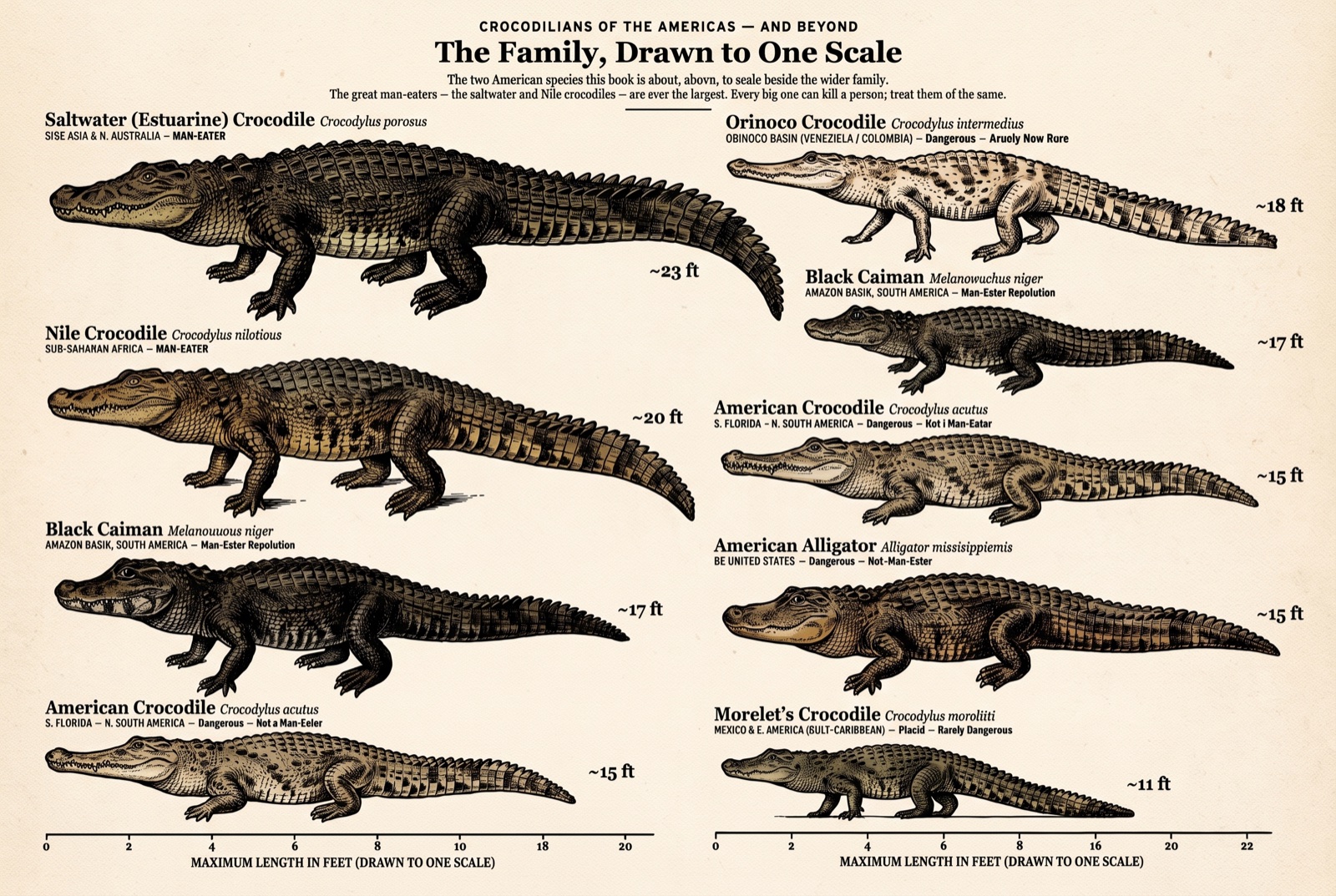
Crocodilians live on every continent except Europe and Antarctica. They bask on the sandbars of the Amazon and the Congo, drift in the canals of Florida suburbs, haul out on Mexican tourist beaches, and cruise the tidal rivers of Borneo. In warm water with something to eat, you will usually find some member of this family. But not always. Plenty of warm places have no native crocodilian at all, so the real rule is to know exactly where you are: do the homework for your region, or use the range guide at the back of this book, which lays out where these animals live and where they do not. This chapter is a short tour of the ones most likely to cross a human life: where they live, how they differ, and why the lesson never changes.
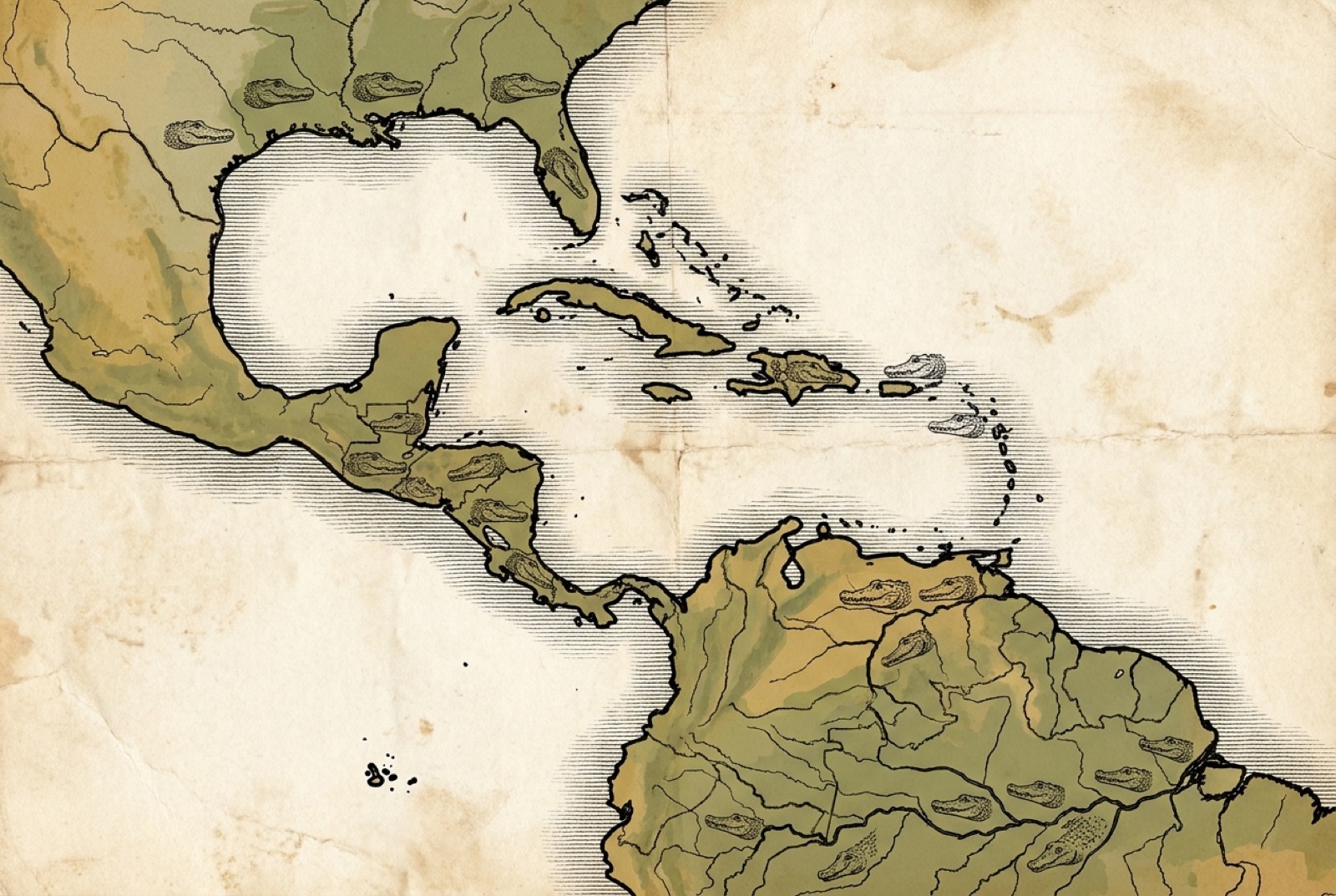
The American alligator, at home in the United States
The American alligator (Alligator mississippiensis) is one of conservation’s great comebacks. Hunted to the brink in the twentieth century, it now numbers perhaps five million across the southeastern United States, from the Carolinas to Texas, with its strongholds in Florida and Louisiana. It lives in lakes, rivers and swamps, and just as readily in the man-made water we build around ourselves. Canals count. As American suburbs have spread into wetland, people and alligators share more edges than ever before.
By the standards of the saltwater or Nile crocodile, the American alligator is relatively wary of people. That reputation is precisely its danger. Fed by hand it loses its fear fast, which is why feeding wild alligators is illegal in Florida. Attacks cluster where people wade or swim in natural water, walk a dog at the bank, or enter the water at dawn or dusk, and they happen in water so ordinary that no one thought to be afraid. In June 2026 a young woman died after an alligator seized her while she swam in a calm Florida river with friends; her story is told, with dignity, in the tragedies chapter. You will hear people call these animals “swamp puppies.” It is all over social media, and honestly it is a pretty good nickname — right up until you do the math on it. That puppy has around three thousand pounds of force behind its jaws, and it is fully capable of killing you. Cute name, apex predator. Alligators are, on average, more placid than the other great crocodilians, but placid is not tame and it is certainly not safe: a large alligator can take a life without much trouble. So there is no such thing as a safe crocodilian in the water with you. The only safe crocodilian is one you are watching from a distance, well back and out of its reach. Keep your body out of any water these animals live in or could move into, observe them from afar and with respect, and they are no threat to you at all.
Leave the handling of alligators to the experts
The American alligator (Alligator mississippiensis) is one of only two alligator species left on earth. The other is the Chinese alligator, a much, much smaller animal, rarely more than five to seven feet, and critically endangered in the wild. (Alligators have close cousins as well: the caimans of Latin America, which belong to the same broader family but are their own group of animals, from the little dwarf caimans to the huge black caiman of the Amazon.) We covered its size and its bite a few pages back, so I will not run the numbers again; even an average adult weighs several hundred pounds and carries one of the most powerful bites ever measured. Federally protected in 1967, the species recovered so completely that it was taken off the endangered list twenty years later. It worked. And yet, of all the great crocodilians, the alligator is the one people are most willing to get close to. By the standards of a saltwater or Nile crocodile it genuinely is more tractable: less reflexively aggressive, more predictable, and more tolerant of handling by someone who knows exactly what they are doing.
That single difference is why so much of our everyday image of a giant crocodilian is, in fact, an alligator. Alligators are farmed in their hundreds of thousands in Florida and Louisiana; they headline wildlife shows and gator-wrestling attractions with roots in Seminole and Miccosukee tradition; they are the animal in the viral clips of a handler hauling a “nuisance gator” off a golf course or out of a backyard pool. We see alligators managed, moved, fed and even wrestled far more often than we ever see a wild crocodile, and the quiet lesson the public absorbs is the wrong one: that these are basically docile animals, a piece of Florida scenery, harmless. They are not. A calmer disposition is not tameness, and a crocodile you seldom see handled is no more dangerous than a gator you constantly see managed. You are simply watching the one that lets professionals get away with more.
Everything you see a professional do with an alligator is the product of training, controlled conditions, a planned escape, a tolerance of risk most people would never accept, and very often decades of reading these animals. A true professional understands an animal’s behavior so deeply that they can usually tell what it is about to do before it does it. But only usually. These are wild, unpredictable animals, and even the most experienced handlers get surprised, caught off guard, injured, and sometimes killed. What you are watching is a demonstration of hard-won expertise, not evidence that the animal is safe. A large alligator remains a wild apex predator with the same jaws, the same ambush instinct, and the same capacity to take a limb or a life as any crocodilian in this book. What a trained handler can do is not a template for anyone else. For the public the rule does not soften an inch: never touch, feed, catch, corner or approach an alligator, and never imitate what you have seen someone else do. Interacting with these animals is for trained professionals only, and even they treat every one as fully capable of killing them, because it is.
And a word on who actually counts as one of those professionals, because it gets more important every year. Social media is full of people with big followings handling animals they have no business touching, and a lot of viewers come away thinking that is what expertise looks like. It is not. Follower count is not knowledge. A real expert is someone who understands the animal all the way down: how it thinks, what it is about to do, how to work with it safely, and when not to push it at all. They do not take unnecessary risks for a clip. Some of the people who have genuinely earned that word, in crocodilians and the wider reptile world, are Tom and Stacey Crutchfield, Kevin McCurley, Chris Gillette, Wes Mannion, Todd Hardwick, and, above all of them, the late Steve Irwin. Learn from people like that. Not from whoever is getting the most views this week.
The American crocodile: Florida, Mexico and Central America
Alongside the alligator, the Americas have a true crocodile: Crocodylus acutus, the American crocodile, a coastal, estuarine animal that ranges from the tip of Florida down through Mexico, Central America, the Caribbean and into northern South America. South Florida is the one place on earth where crocodiles and alligators live side by side; there the crocodile is a shy, recovering, protected species that rarely troubles anyone. One mix-up needs clearing up. Because the American crocodile is at home in salt water, and turns up out in the ocean and along the coast, people sometimes call it a “saltwater crocodile.” Fair enough. It does swim in salt water. But it is not the saltwater crocodile, Crocodylus porosus, the giant of Australia and Asia that everyone pictures and that will actively hunt people. Those are two very different animals, and that loose nickname is exactly what confuses them. The American crocodile, for all that it can grow impressively large, does not regard humans as prey the way the Indo-Pacific saltie does. That does not make it harmless, but it makes it a fundamentally different neighbor than the man-eater on the other side of the world.
Further south the picture changes. It changes hard. Along Mexico’s Pacific coast and through Central America, fatal attacks by American crocodiles do occur: on tourist beaches, in marina channels, and in the mangrove estuaries that resorts are built beside. The crocodile taken from a Puerto Vallarta marina beach in June 2026 was one of these animals: protected native wildlife, living where it had always lived, in water a visitor mistook for a swimming beach. Feeding, habitat loss and a rainy season that pushes crocodiles onto the coast all drive the conflict. Where you see mangroves, an estuary, a marina or a river mouth in the American tropics, assume crocodiles, whatever the postcard says. Some of the most important work on this animal today is led by Dr. Marisa Tellez, whose research and hands-on conservation across Belize and the region has done a great deal to change how we understand and protect the American crocodile.
Alligator and American crocodile: two neighbors, told apart
Because south Florida is the one place on earth where the two live side by side, you should understand how they actually differ. Not as a safety test, since both get identical treatment. Knowing the animals is the foundation of respecting them. Start with water. The alligator is at heart a freshwater animal: it lacks the salt-shedding glands on the tongue that true crocodiles have, so while it can tolerate brackish water and even turn up briefly in the surf, salt slowly wears it down and it cannot stay. The American crocodile carries working salt glands and is built for the coast: estuaries, mangroves, Florida Bay, the Keys, and the open shore, which is why a crocodile can be waiting on an ocean beach where an alligator almost never is. That single difference in physiology shapes where each animal lives and which one you are likely to meet, and where.
Look, and they tell themselves apart. The alligator is broad-snouted and very dark, almost black, and with its mouth shut it hides its lower teeth behind the overhanging upper jaw. The American crocodile is lighter, olive, gray or tan, with a narrower, more tapered snout, and it shows a toothy grin when closed, the large fourth tooth of the lower jaw sitting outside the mouth in plain view. In size they are well matched: a big bull alligator runs eleven or twelve feet, and a large American crocodile matches or beats it, commonly reaching twelve to fourteen. Both are huge. Temperament is the difference people most want to hear about, and it must be handled honestly. In the United States the American crocodile is genuinely shy and retiring, so much so that a Floridian is far more likely to have trouble from an alligator, simply because there are millions of alligators and only a couple of thousand crocodiles, and the alligator is the one that colonizes ponds and canals where people are. But that shyness is a Florida story. The very same species, farther south along the coasts of Mexico and Central America, is involved in fatal attacks every year. Neither animal, as a rule, regards a person as food, and neither reservation is one to rely on, because a defensive, territorial, startled, or food-conditioned animal of either species kills exactly the same way. Learn the differences for the pleasure and the understanding of it. Give both the identical wide berth for your life.
Mexico and Central America, where the crocodiles take over
South of the border the alligator vanishes. No gators at all. The true crocodiles take charge. The American crocodile works both of Mexico’s coastlines, the Pacific from Sinaloa south and the Gulf and Caribbean shores, and carries on down the whole spine of Central America, through Belize, Guatemala, Honduras, El Salvador, Nicaragua, Costa Rica and Panama, hunting the mangroves, river mouths and estuaries that the resort brochures never mention. Costa Rica’s Tárcoles River holds one of the densest American-crocodile populations anywhere on earth. Sharing the Atlantic freshwater lowlands with it, from the Gulf states of Mexico across the Yucatán and into Belize and northern Guatemala, is a second, shyer true crocodile, Morelet’s crocodile, an animal of marshes, lagoons and forest rivers. And threading through nearly all of these same wetlands is the spectacled caiman, the most widespread crocodilian in the Americas and, more often than not, the first one a visitor to any tropical wetland will lay eyes on.
South America, caiman country
South America is where the family fans out. Its largest and rarest predator is the Orinoco crocodile, the biggest crocodilian in all of the Americas (historical records approach twenty-two feet), and a genuine historical man-eater. Today it survives only in the Orinoco basin shared by Colombia and Venezuela, its wild numbers fallen to a couple of hundred or so, so the danger it once posed is now mostly a thing of the past. The American crocodile follows the Caribbean and Pacific coasts as far south as northwestern Peru. Everything east and inland belongs to the caimans: the great black caiman, the largest of all the caimans at over twenty feet, apex predator of the Amazon and a proven killer of people, ranges across Brazil, the Guianas and the western headwaters of Colombia, Ecuador, Peru and Bolivia; the yacare caiman swarms the Pantanal and the Paraguay–Paraná system; the broad-snouted caiman reaches furthest south, into northern Argentina and Uruguay; and two small dwarf caimans, Cuvier’s and Schneider’s, hide in the clear forest streams and threaten no one. You do not need to memorise the list. Nobody does. You need only know that from the Amazon to the Pantanal, some crocodilian is holding nearly every stretch of water there is.
The Caribbean islands: a wanderer, an island jewel, and an intruder
The islands hold two native crocodiles, and it pays to tell them apart. The American crocodile is the coastal wanderer: the only crocodilian in Jamaica, a resident of Hispaniola shared by the Dominican Republic and Haiti (including the strange, hypersaline Lago Enriquillo, one of the largest crocodile populations in the Caribbean), and a presence around the shores of Cuba and the Cayman Islands. Cuba also guards a jewel found nowhere else on earth: the Cuban crocodile, a boldly patterned, unusually agile animal now confined to the Zapata Swamp and a reintroduced population on the Isla de la Juventud, the smallest wild range of any crocodile alive. One swamp, one island. It is capable and deserves real respect, but so few and so localised that it is a conservation treasure long before it is a hazard.
Puerto Rico tells a different island story again. It has no native crocodilian. But since the 1960s an introduced population of spectacled caimans, descended from released pets, has gone feral and firmly established itself as an apex predator, with its stronghold in the Tortuguero Lagoon reserve at Vega Baja on the north coast and a foothold in reservoirs and lakes such as Toa Vaca and Guajataca across the island. They are a genuine and growing presence. Not a curiosity. And a reminder that people move these animals as surely as any flood does. Trinidad, at the southern end of the island chain, shares the caimans of the nearby South American mainland, the spectacled caiman among them.
The four to keep well clear of in the Americas
Of the roughly eight crocodilians native to the Americas, only a handful are documented dangers to human beings, and here they are. Two you may actually meet: the American alligator across the southeastern United States, and the American crocodile along the warm coasts from Florida to Peru. Both have killed people. Two more belong on the list from farther south: the Orinoco crocodile, a historical man-eater now too rare to pose much present risk, and the black caiman of the Amazon, a proven predator of humans whose attacks, most often on fishermen hauling nets, are confirmed in the record, including a peer-reviewed fatal case of a child. And cross-referencing the modern attack databases adds one name the older books wave off as harmless: Morelet’s crocodile, which has in fact caused dozens of attacks and over a dozen recorded deaths in Mexico over the past decade. So much for harmless. The rest of the family, the spectacled, yacare, broad-snouted and dwarf caimans, will bite in self-defence and can hurt you, but as a rule they are not large enough to pose a real threat to your life. The rule does not change with the name: the dangerous ones and the harmless-looking ones ask you for exactly the same distance.
The Nile crocodile of Africa
Few animals alive kill more people than the Nile crocodile. It ranges across sub-Saharan Africa and Madagascar: in the great rivers and lakes, the Zambezi and the Nile, Lake Turkana and the Okavango, and the Mara and Grumeti where the wildebeest herds cross each year and the crocodiles wait. And they wait well. Large and powerful, it is far bolder than the American alligator or American crocodile, and it is reliably recorded killing hundreds of people a year. Because so many attacks in remote country are never reported at all, the true toll is certainly higher, quite possibly approaching a thousand.
For millions of Africans this risk arrives every day. Every day. The danger falls hardest on the people who have no choice but to use the water: fishing, collecting water, washing clothes, watering livestock at the same banks the crocodiles patrol. Their reality is a reminder that being croc wise is, for much of the world, simply how you stay alive; and that the safest water’s edge is one you have given a wide and deliberate berth.
The saltwater crocodile beyond Australia: Asia and the Pacific
The saltwater crocodile, the giant of northern Australia and tropical Asia, is the most widely distributed crocodilian on earth. It lives along the east coast of India and through the Sundarbans of India and Bangladesh, across Southeast Asia, and through the vast Indonesian archipelago, the Philippines, New Guinea and the Pacific islands. The Philippines produced Lolong, the largest crocodile ever reliably measured, over twenty feet long.
It is in this region, not Australia, that most of the world’s crocodilian attacks happen. Indonesia records more than anywhere else on earth, driven by huge coastal populations living and working among the mangroves, fishing, sand-mining, tending fish ponds, at the water’s edge the crocodilians own. Not tourists. Working people. Same animal, same rule as anywhere else. The difference is how many people have no way to keep their distance.
Do they see you as prey? A survival ranking
One of the most useful things to know about any crocodilian is how readily it will treat a person as prey. Two species stand apart: the saltwater crocodile and the Nile crocodile. They are the great man-eaters, between them responsible for the overwhelming majority of the world’s fatal attacks. It is not that they hunt people out of any special malice. No malice. Like all crocodilians they are opportunists. But they are big enough, bold enough, and live among enough people that, to them, a person at the water’s edge can simply become the next opportunity.
A second group is dangerous in other ways. The mugger crocodile of India and Sri Lanka kills a notable number of people each year, a genuine, under-publicized man-eater, though many of its attacks are territorial or defensive rather than predatory. Closer to home, the Americas hold two large crocodilians of their own. The black caiman, the great predator of the Amazon, has a real man-eater’s reputation among the river communities who live alongside it. The Orinoco crocodile, one of the largest crocodiles in the New World, was a serious danger a century ago; today it is critically endangered, with so few left that attacks have all but ceased, a reminder that “dangerous” and “endangered” are not opposites. (Morelet’s crocodile of Mexico and Central America was long written off as small and shy, but the modern attack records tell a harder story, dozens of attacks and over a dozen deaths in the past decade, most in Mexican freshwater, so it, too, belongs among the animals to keep well clear of.) Farther afield, the false gharial of Borneo and Sumatra, long thought harmless behind its slender, fish-catching snout, is now confirmed to have killed and eaten people, though such attacks remain rare. Rare, not impossible. And most other large crocodilians are simply opportunists: an animal that reaches thirteen or sixteen feet does not draw fine distinctions about what will fit in its mouth.
For the two animals this book is about, the American alligator and the American crocodile, the reassuring part is real: as a rule, neither regards a human as food. Their attacks are usually something else: a territorial male, a female defending her nest, or a strike set off by splashing that mimicked struggling prey and was mistaken for a meal. But “they don’t eat people” gets heard as “they’re safe,” and that is exactly why people die. Dead is dead. A defensive bite from a ten-foot alligator kills you just as thoroughly as a predatory one. Not being hunted is not the same as being out of danger.
Different animals, one rule
An alligator in a Florida pond, a crocodile on a Mexican beach, a Nile crocodile at an African crossing, a saltie in an Indonesian estuary. They are one family, and they ask one thing of us. Whatever the name, whatever the continent, whatever the size, a crocodilian is simply not an animal you swim with or wade around. The calm ones, the clear ones, the shallow ones, the crowded tourist ones, the ones with no history of an attack: none of it changes what the animal is. Treat every one as capable of killing you, keep your distance, and admire them from afar and with respect.
Different names, different continents, different sizes. One family, and one rule: keep your distance, every time.