19 · Page 174 of 219
Why Crocodilians Matter
The largest reptiles on earth, and why we need them
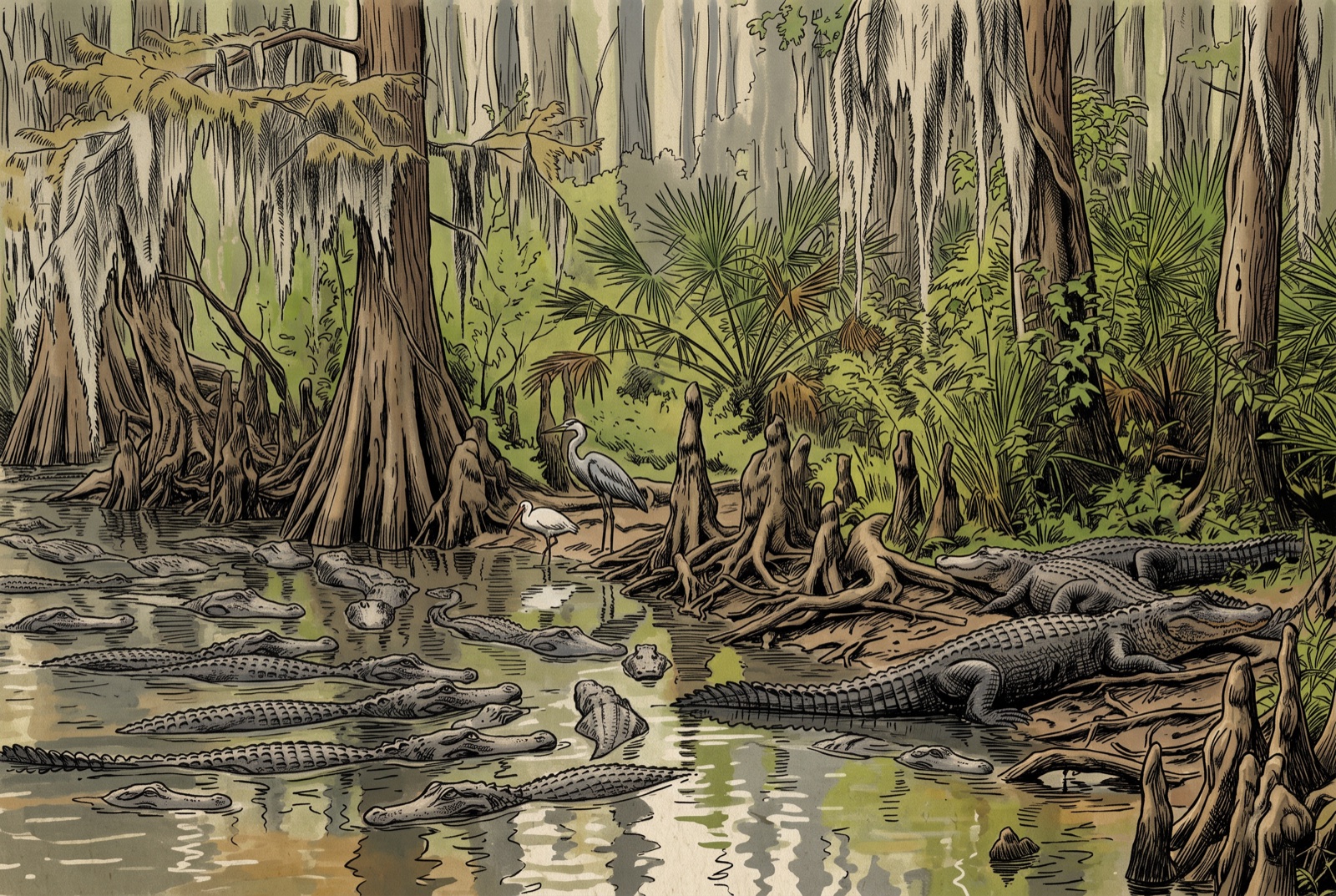
It would be easy, after a chapter of tragedy, to think of crocodilians only as a threat to be endured or eliminated. That would be a profound mistake. Ecologically, culturally, and morally. Crocodilians are not a flaw in an otherwise pleasant landscape. They are among the pillars holding it up, and creatures whose survival reflects something important about who we choose to be.
An apex predator and a keystone species
As the top predators of the rivers, swamps and wetlands where they live, crocodilians shape the entire ecosystem beneath them. Scientists describe crocodilians as apex predators and keystone species: animals whose presence regulates the populations of other species, maintains the balance and structure of the food web, and helps keep the whole freshwater and coastal system healthy and resilient. Remove crocodilians and the system does not become safer. Or richer. It becomes unbalanced. Predators at the top keep prey populations in check, recycle nutrients through the system, and sustain a diversity of life that collapses without them. Crocodilians are, in the truest sense, load-bearing.
So think for a second about what actually happens if you decide to just get rid of them. Pull the alligators out of a southern wetland and you do not get a safer, tidier version of the same place. You get a broken one. The gator holes they dig, the deep pockets of water that carry fish, turtles, birds and everything else through the dry season, stop being maintained and dry out. The prey they held in check booms, then crashes. The wetland that was shaped around them starts to come apart. Piece by piece. That is what “keystone” actually means: pull the keystone and the arch does not sag, it falls. And there is a plainer point sitting underneath the biology. We are the dominant species on this planet, and dominance was never supposed to mean only taking. It was supposed to mean looking after the place. We have gotten very good at the dominating and pretty bad at the taking-care-of, and deciding a wetland is better off with its top predator alive in it is one small, correct step back toward the balance.
A conservation triumph we should be proud of
The American alligator’s recent history is one of the great conservation success stories of the modern era, and a story that should change how we think about the animal. Through the nineteenth and into the twentieth century, relentless hunting for hides and meat, together with the draining of wetlands, drove it toward oblivion; by the 1950s and ’60s the alligator had vanished from much of its former range and seemed to be heading the way of so many overhunted species. In 1967 the federal government listed it as endangered, and the hunting was shut down. All of it.
Protection worked, and fast. Within two decades the alligator had rebounded so completely that in 1987 it was declared recovered and taken off the endangered list, one of the earliest and most emphatic victories of American wildlife law. Today perhaps five million alligators live across the Southeast. The American crocodile has followed the same arc more slowly: hunted and squeezed by coastal development down to a few hundred animals in south Florida, it was listed as endangered in 1975 and has since climbed back to a couple of thousand, enough to be downgraded to threatened. Two species pulled back from the edge by human decisions to protect them: the hopeful half of the story this whole book tells. It is also why complacency is no longer an option: success brought the animals back into waters where people now live and play.
From the brink and back
Hunted to the brink by the 1960s. Listed as endangered in 1967. Recovered so completely it was delisted by 1987. Perhaps five million today. The American alligator is proof that when we decide to let a species live, it can.
A cultural icon
Beyond ecology, these animals are woven deep into the identity of the places they live. In the American South the alligator is an icon: of Florida and Louisiana, of the swamp and the bayou, of a wild country that still has genuine teeth; it fronts sports teams, folklore and a whole regional sense of place. It runs deeper still in the traditions of the South’s Native nations. Much deeper. The alligator there is a figure of story and respect, held so for countless generations. To live in the American South is, in part, to share it with this animal. Because of what it is, not in spite of it.
That runs deeper than mascots and sports teams. Among the Seminole and Miccosukee of Florida, who have lived beside these animals in the Everglades for generations, the alligator holds a place of genuine respect in clan tradition, story and ceremony; even the alligator-wrestling that later hardened into a roadside spectacle grew out of a real, working relationship with the animal. It threads through the oral traditions of the Choctaw and other Southeastern nations too, turning up as a figure that teaches, warns, or helps the people. And the reverence is older still, and reaches across the whole hemisphere: in the civilizations of ancient Mexico the crocodilian became Cipactli, the primordial earth-monster from whose body the world itself was made, the animal that quite literally holds creation up. For thousands of years, from the Everglades to the Valley of Mexico, the people who actually lived with these animals did not treat them as vermin to be wiped out. Not vermin. They treated them as powerful, and worthy of respect. That is the older default, and the wiser one, and it is exactly the one this book is asking you to return to.
A landscape with crocodilians in it is not something to be tamed or emptied. It is part of who this country is, woven through the culture of its Native nations and its Southern states alike, and it asks for respect, not conquest.
They were here first, and they will always find their way home
Say it plainly: these animals were here first. Crocodilians have held their place for more than two hundred million years (they watched the dinosaurs come and go) while our own species has existed for a few hundred thousand. When a crocodilian turns up on a Mexican resort beach or an alligator in a Florida subdivision’s pond, it is not an intruder in our world. Not an intruder. We are the newcomers in theirs. Almost every flashpoint of conflict traces back to the same cause: habitat we took. Resorts built across the mangrove estuaries of Jalisco and Nayarit; suburbs, canals and golf courses paved over the wetlands of the American South. We moved onto the water’s edge, and then called the animal that was already there a problem.
One fact ought to end the fantasy of simply removing them: crocodilians home. Catch one, truck it far away, release it. More often than not it comes back. Satellite-tracked saltwater crocodiles have returned to their exact capture sites by the most direct coastal route; even young alligators navigate home after being moved. Relocation mostly fails, because the animal keeps returning to the place that was its home before it was ours. Its home. The honest conclusion is not comfortable, but it is the only one that works: we cannot keep evicting an animal that was here first and will not stay evicted. Learning to live alongside it is not sentiment. It is the only strategy that has ever actually worked.
That homing instinct is also the quiet reason so many “nuisance” alligators are killed instead of moved. Ask a wildlife officer and they will tell you that you cannot simply haul a big gator off somewhere and let it go, because more often than not it turns straight around and comes back, sometimes over remarkable distances. Studies that tracked translocated alligators watched them navigate home across dozens of miles; the most striking crocodilian homing records of all, in the saltwater crocodiles of Australia, run into the hundreds. So the animal effectively gets a death sentence for the crime of being good at going home. Think about that. It does not have to be that way. Part of what we are working toward at Citadel Culebra and the projects around it is a real alternative: funded sanctuaries and facilities that can take in these animals and give them somewhere to live, instead of defaulting to a needle. A crocodilian that cannot be released where it was found is not automatically one that has to die. Building the places that can actually hold them is one of the concrete things we intend to push for.