
18 · Page 153 of 219
The Attacks, Analysed
The decisions, case by case, and what runs through all ten
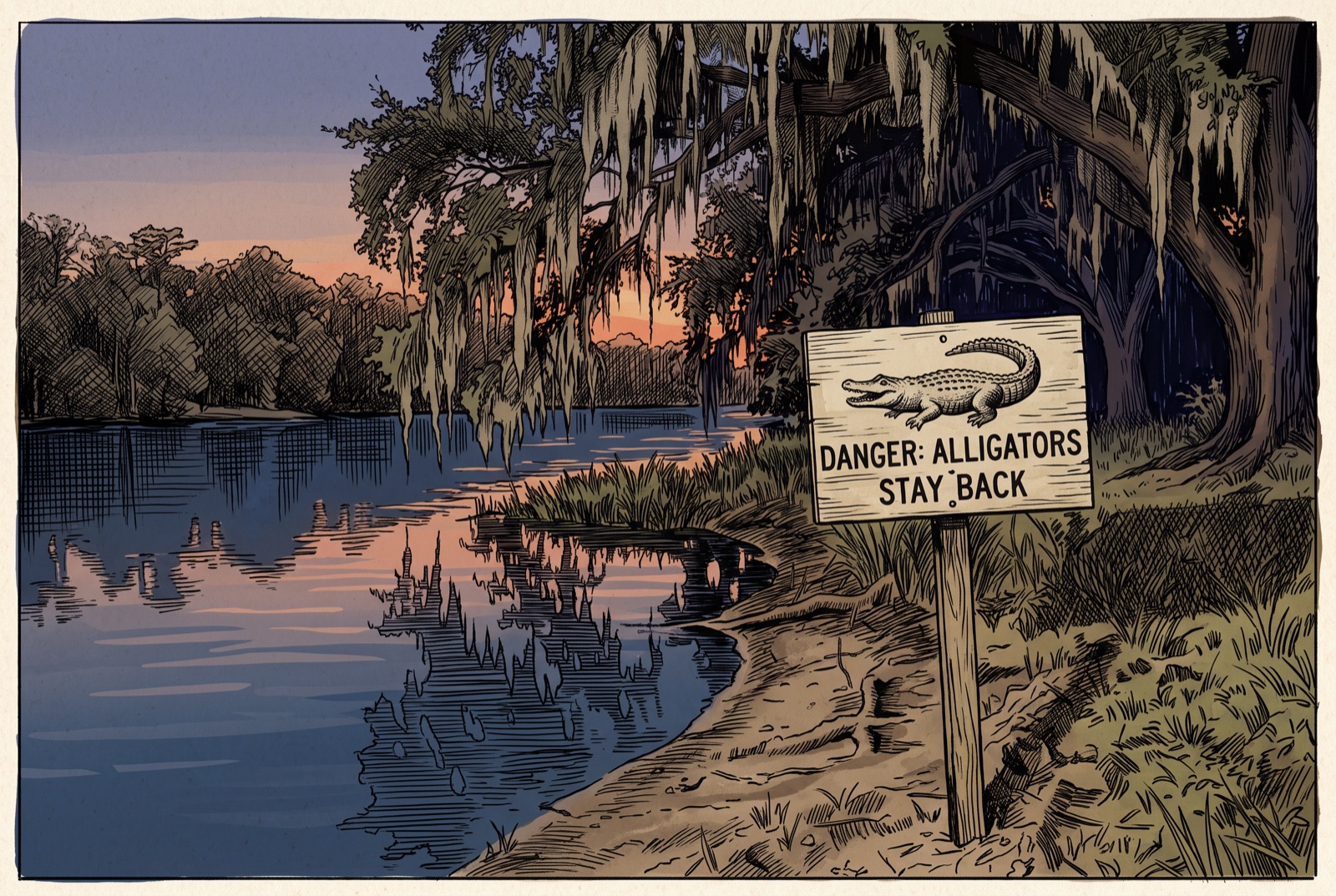
Now the part that can change something. Going through ten deaths and maulings one at a time, naming what could have gone differently, is uncomfortable work, and I want the terms set before we start. Nobody here deserved this. Several of them had no way at all to know, which means the honest finding in their case has nothing to do with them and everything to do with a sign nobody put up, a feeding nobody stopped, or a lagoon nobody fenced.
Some of the worst decisions in these ten cases were made by people who never went near the water and never got hurt.
One case is different, and I will name it when we get to it.
There is a second line running through this chapter, and it separates cases that look identical from the outside. Some chose the water. Some were put in it, or were too small to have any say at all. A two-year-old at a resort lagoon. An eleven-year-old boy releasing a fish beside his father. A girl of eleven in Rondônia. Children do not assess risk; adults assess it for them, or fail to, and that assessment usually happens hours earlier and somewhere else entirely.
Oscar Scherer, 1973
There is nothing to assess in Sharon Holmes’s case, and that absence is the assessment. No hour, no depth, no account of the decisions anybody made that day. What I can name is the institutional one. In 1973 there was no accessible body of data a Florida family could have checked before letting a sixteen-year-old near a state park waterway, because the fatality table that would have told them anything at all begins with her. She is row one. Everything after her is a number somebody can now look up before they make a call about a swim.
Data is safety equipment. It is unglamorous, it does not look like anything, and a family checking a table before a trip is not a scene anybody films. Florida has one. Most of the places in this chapter do not, and that difference shows up in this book as whole cases I could only give you four sentences of.
Guajará-Mirim, 2010
I will not tell you what that girl was doing at the water, because the paper does not say and inventing it would be worse than leaving the gap. So the finding here is about the animal, and about who gets counted as at risk. A black caiman of 4.21 metres is not a lesser version of a thirteen-foot alligator. Not remotely. It is the same size of problem with a different name on it, in a part of the world where a great deal of ordinary daily life happens within arm’s reach of a river, and any list of American crocodilians that files the caimans away as the small ones is a list that will get somebody hurt.
Seven Seas Lagoon, 2016
The Graves family did nothing wrong, and I want that sentence to sit on its own before anything else in this section.
They were on a groomed beach at a world-famous resort, at an outdoor movie, with their two-year-old playing in a few inches of water at the edge. The signs at that lagoon warned against swimming. They named no animal. A family from Nebraska reading that sign got exactly one piece of information out of it, which is that the management would rather they did not swim, and nothing whatsoever about what was living in the lake.
So the avoidable decisions in this case were taken months and years earlier, in an office, by people who were never in any danger themselves. Two questions. Whether to name the animal on the sign. Whether to put a barrier between a public beach and a natural Florida lagoon. Both were answered after Lane Graves died: the resort built a low boulder wall and posted warnings with pictures of alligators on them. Every part of that was buildable the year before.
And keep the animal question straight even here, because there is a version of this story going around in which an alligator gets blamed by name. Two were removed, at seven to eight feet. Nobody ever matched one. The lesson does not need a named animal, and the record does not have one to give.
Velas Vallarta, 2022
Two people survived an American crocodile at a Jalisco resort beach in 2022, and four years later Irving Mauricio died on the same coast. That is the finding. All of it. A non-fatal attack is the cheapest warning a stretch of coastline will ever get: it costs nobody their life, it arrives with names and dates attached, and it lands directly in the lap of every hotel and every municipality on that shore.
What was done with that warning between 2022 and 2026 is not something I can document. The outcome is documented well enough.
McKay Creek, 2023
Sabrina Peckham’s case does not hand me decisions to name. It kills an assumption instead. A common one. Ask most people in Florida how big the alligators around houses and creeks get and you will hear eight feet, maybe ten, and the animal in her case was thirteen feet eight inches, in a creek in Largo, which is a town rather than a wilderness. If your mental picture of the animals living near people tops out at ten feet, the fatality table disagrees with you, and the table is built out of measured animals.
Cañas River, 2023
The American crocodile has a gentle reputation next to the crocodiles of Africa and Australasia, and there is something real underneath that reputation. It is also the species that killed Jesús López Ortiz at twenty-nine on a Costa Rican river, and Irving Mauricio at twenty-eight on a Mexican beach, three years apart. A large American crocodile that is defensive, or startled, or has been fed by people, kills an adult as completely as anything else in this book. Reputation is a population-level statement. Averages are averages. It is no use at all to the person standing at the water’s edge.
Marina Vallarta, 2026
This is the case where the decision that killed a man was made by somebody who was not on that beach.
Marriott says signage and red flags were in place. Chris Bury, who was standing on the sand and ran for a kayak, says there were no warning signs at all. No verdict from me. But a hotel and an eyewitness who cannot agree on whether a beach was signed have told you something anyway: whatever signing existed was, at absolute best, not obvious enough for a man in a crisis to remember seeing it. A sign that nobody on the beach registers is doing no work at all.
The rest of it was hour and habitat. Half past six in the evening. The light going. A beach beside a marina and a mangrove estuary on the Pacific coast of Jalisco, in late June. That is American crocodile country, and has been for far longer than there have been hotels standing on it.
One more thing about how this case gets told. Irving Mauricio was a Mexican lawyer travelling in Mexico, and a lot of the coverage turned him into a tourist. That word does work. It tells everybody who lives on that coast that the danger belongs to visitors, and it tells everybody who visits that the locals must know something they do not, and neither of those is true, and both of them keep people standing at the edge of that water after the light goes.
Nelson Fish Camp, 2026
Brodie Terry was eleven, on holiday, doing the thing his father was standing right next to him doing. There is no version of this where the boy is at fault. None. I am naming decisions in this chapter, not people.
The decision that carried the risk was geometry. Hands at the waterline. A hooked fish thrashing in them, in alligator country, at a fish camp. A struggling fish broadcasts the exact signal these animals are built to find and pulls them in toward the bank, which means the danger was never out where the line went into the water. It was in the last two feet of it.
His father went into the water on top of the animal. I am not calling that a mistake. Not for a second. I do not believe there is a parent alive who reads that sentence and thinks they would have done something else. It was also, plainly, about as dangerous an act as anything in this chapter, and both of those things are true at the same time.
The roll took the hand while the boy was alive and fighting. That sequence is why this book keeps putting your safety in the minutes before contact instead of the seconds after it. Eight feet seven inches. Once an animal that size has hold of an arm and commits to the roll, the outcome is set by its mass and by the physics of the twist, and not by how hard the people on the bank are pulling.
Econlockhatchee River, 2026
This is the case I said was different.
Every other person in this chapter was missing something. A sign, a barrier, a warning, a piece of knowledge nobody had ever handed them. Brittany Clark had been told, that same day, by a man who had walked those trails for thirty years, that there were a lot of alligators in that water and that she should stay out of it. The information was there. It was delivered by somebody qualified to deliver it. It was set aside, and she went in shoulder-deep and swam.
I am not going to be cruel about that, and I am not going to soften it either, because softening it would waste the only useful thing her death can still do. Warnings from people who know the water are the cheapest safety equipment in existence. They cost nothing. They are handed over by strangers who gain not one thing by handing them over, and they get set aside constantly, usually by people who are having a good day and would rather not have it interrupted.
The autopsy gives blunt force trauma sustained in the struggle, and not blood loss. Read that against what most people assume about these attacks and about first aid. The picture in everyone’s head is catastrophic bleeding and a tourniquet, and what actually killed her was the mechanical violence of being seized and rolled by a thirteen-foot animal. Chance Allison did what a person can do. He fought it off her, brought her to the bank and did CPR, and none of that could undo damage already done inside her.
The other correction is one this book owes her. Earlier editions said a second person, a juvenile, was bitten in the same incident. That never happened. The line came from a headline that stacked her death together with Brodie Terry’s injury in Marion County the day before, and it has been repeated since by people copying the headline instead of the story underneath it. Different river. Different day. Getting that right is part of telling the truth about her.
Casa Cenote, 2026
Every avoidable decision in this case was made before the day it happened, by people who walked away fine.
A crocodile at Casa Cenote had a name. Panchito. People had been feeding it for years, and warnings about where that was heading had been given across those same years. Then a man of seventy-five was bitten, and it was treated as a surprise.
Whether tourists were throwing rocks at it that day is contested, the venue tells it differently from the witnesses, and I have already said I will not settle that. It does not change the finding much either way. Habituation takes years. It is built out of a hundred small handouts, by people who each think their one piece of bread is harmless, and by an operator who decides that a crocodile visitors can get close to is either good for business or simply not their problem to solve.
And the animal pays for it too. Three of these ten cases end with a crocodilian killed or taken out of the water, and in most of the rest the record just does not say. Two alligators out of the Seven Seas Lagoon. Two out of the Econlockhatchee. One killed at Nelson Fish Camp. Whatever became of Panchito. Feeding a crocodile is a decision to have it destroyed later, on a timetable set by whoever it eventually bites.
What runs through all ten
Set the ten side by side and the same handful of conditions keep turning up, and not one of them is exotic.
Low light
Lane Graves was taken after dark. Irving Mauricio at half past six in the evening with the light going. That is the crocodilian hunting window across every species in this book, and it is also, by an unfortunate coincidence of human habit, the hour a hot day cools off and people head for the water. Not every case here fits it. Brodie Terry and Brittany Clark were both attacked in daylight, and bending that to make the pattern tidier would be doing you a disservice. Low light raises the odds a long way, and daylight does not take them off the table.
The edge
Almost nobody in this chapter was taken from the middle of open water. They were at the margin — ankle-deep at a lagoon. Crouched over a bank with a fish in their hands. On a beach. In the first stretch of a river. The margin is where an ambush predator holds every advantage it owns at once: cover, depth it can vanish into, and a target standing on ground that gives it a straight run in.
Depth tells you nothing
Lane Graves was in a few inches of water. Brittany Clark was in over her shoulders. Irving Mauricio was at a beach and was recovered several hundred metres out to sea. Three cases. Three completely different depths, and depth predicted none of it. The belief that you can read a waterway’s safety off how deep it is, or how clear it is, survives because it is comforting and because most of the time nothing happens to the person who believes it.
Size predicted nothing either
Run the measurements from these ten cases together and go looking for a floor. Eleven feet three inches, 1973. Thirteen feet eight inches at McKay Creek. Thirteen feet in the Econlockhatchee. A black caiman of 4.21 metres in Rondônia. And eight feet seven inches at Nelson Fish Camp. That last one is an ordinary alligator. You could find its twin in a great deal of Florida water on any given afternoon, and nothing in these ten cases marks out a size at which one of these animals living near people becomes something you get to ignore.
The bites we build
Somebody made one of these. Panchito was fed for years by people who each thought their own handful of whatever it was could not possibly matter to anything, and the bite at the end of it was the last event in a long sequence, every earlier step of which involved a human hand and a piece of food. That is the class of incident easiest to stop, because stopping it costs a decision rather than a budget. It is also the class that gets the animal destroyed afterward, for doing the thing people spent years teaching it.
The survivors
Three of these ten cases have somebody who walked out of it. Brodie Terry, the two people at Velas Vallarta, and the man at Casa Cenote. I went looking for what they had in common and came up short. No pattern. The files on two of the three run to about four sentences, which is not enough to reason from, and the one thing I will point at is that none of the survivors was taken out into open water and held under, while the people who were taken out into open water are all in the other column.
The warning given, and the warnings that never were
One out of ten. In that one case the information reached the person and was set aside. In several of the others it never reached them at all, because the sign named no animal, or there was no sign, or the two people who could tell you whether there was a sign do not agree with each other. Those are different failures and they need different fixes, and they get lumped together constantly by people who want one tidy moral out of half a century of deaths.
The first is personal. Listen to the person who knows that water, especially when their advice is inconvenient and it is coming from a stranger. The second is institutional, and it costs money, and it gets done after somebody dies about as often as it gets done before.
Chosen, or put there
Three of the ten were children. Look at that. A two-year-old, an eleven-year-old boy, and an eleven-year-old girl in Rondônia. None of them made a risk assessment, because that is not a thing children do, and the adults with them were working from whatever information the place had handed them, which at the Seven Seas Lagoon amounted to a sign about swimming.
Which is why the decisions in this chapter that make me angriest are the ones taken in offices. A family cannot fence a lagoon. A visitor cannot sign a beach. Neither can you. Whoever owns the water owns those choices, and when they get made late, the people who pay for the delay are very often the smallest ones standing at the edge.
The record itself
Half of these cases have almost nothing in them, and that is a pattern too. Sharon Holmes, Sabrina Peckham, the two people at Velas Vallarta, Jesús López Ortiz, the girl in Rondônia. Ages, places, years. In three of them, a measured animal. Florida has an agency publishing a fatality table that runs back to 1948, and it is the only reason the American cases in this book can be checked at all. Mexico has 250 documented conflicts through 2021 and no live tracker at all. You cannot manage what nobody is counting.
The other two books
This edition covers the Americas. The Africa and Australasia editions run the same exercise over the Nile crocodile (Crocodylus niloticus) and the saltwater crocodile (Crocodylus porosus), with their own ten cases apiece, their own agencies and their own gaps. The animals in those books are larger and there are a great many more people at the water with no say in whether they go. What travels between the three books is the list above. Low light. The edge. Depth that told nobody a thing. A warning given, or a warning nobody thought to give. Different animal, same afternoon.
The list of habits that would have changed the outcome in most of these cases is short — almost insulting, next to the weight of what it prevents.
- Stay back from the edge of any natural water in crocodilian country, and treat the first few feet of bank as part of the water.
- Get people and dogs away from the water before the light goes, and keep them away until it is fully light again.
- Do not judge safety by how deep or how clear the water is. It tells you nothing.
- Never feed a crocodilian, and never leave fish scraps, bait or food waste in or beside the water.
- When somebody who knows that water tells you to stay out of it, stay out of it.
None of that requires you to know a thing about crocodilian biology, and all of it is free.
One last thing. After Lane Graves died, the resort built a low boulder wall along the shoreline of the Seven Seas Lagoon and put up signs with pictures of alligators on them, in plain language, where a family from out of state would read them on the way down to the beach. Both were buildable in 2015.