
17 · Page 131 of 219
The Attacks, in Full
Ten cases, as far as the record will take us
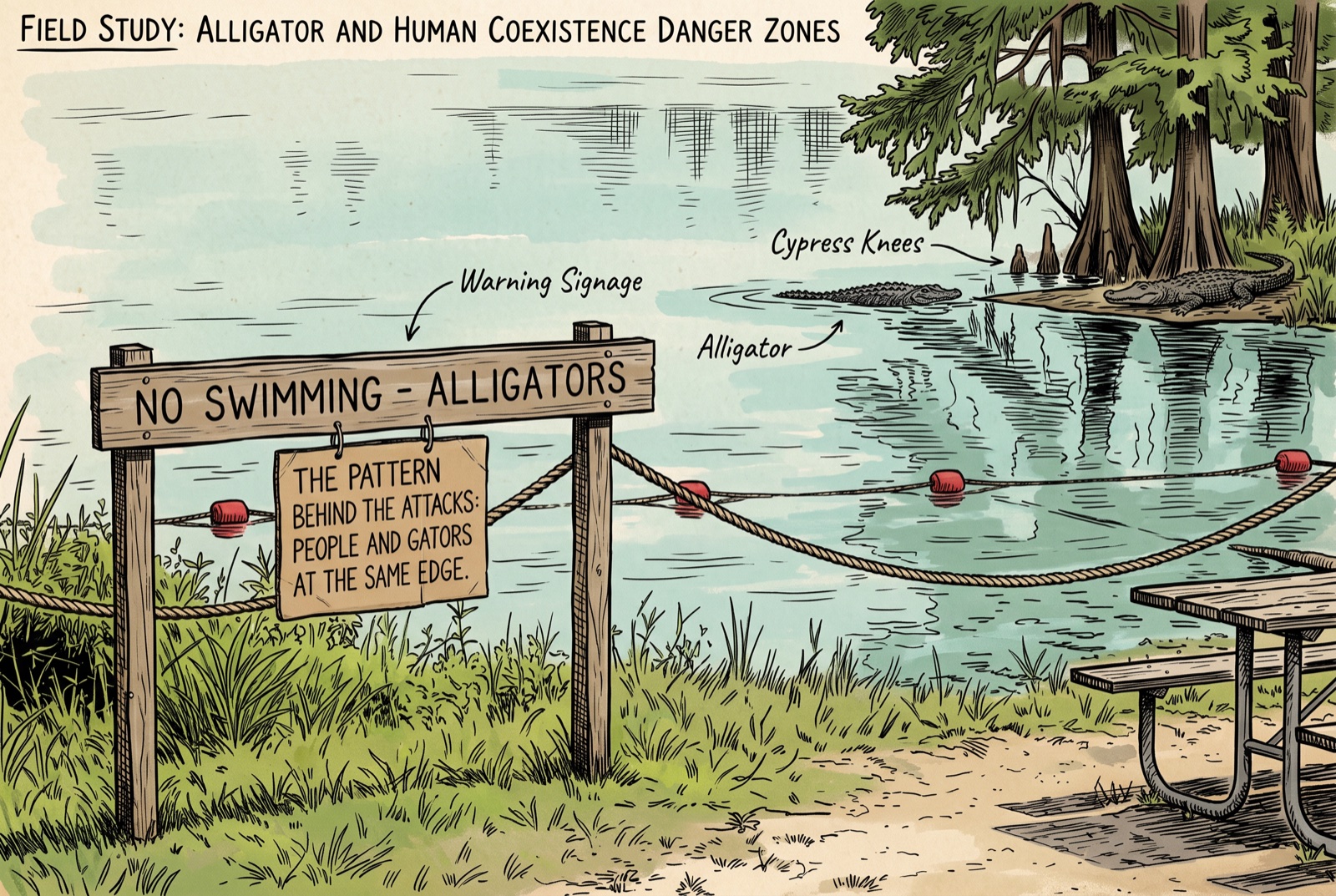
Ten cases follow. Each one told once, as fully as the public record allows, and then left alone. No lessons here. You get those in the next chapter, and they will be easier to trust once you have read the raw material without me leaning over your shoulder telling you what to think about it.
The records are not equal, and pretending otherwise would be its own kind of lie. Some of these people died in a country with an agency that keeps a fatality table, and I can give you the hour, the depth of the water and the length of the animal to the inch. Others reach us through a single peer-reviewed case report, or a handful of local news stories, and the file does not even carry a name. Where a detail is missing, I say it is missing. No filling in. Where two sources disagree you get both of them and no tidy answer.
One more thing about the shape of the list. These ten are American cases, because this is the Americas edition, and the Nile and saltwater crocodile attacks everybody wants to talk about live in the companion books where they belong. Two species that occur in this region got left out because there was nothing honest to put in the slot. I come back to those two at the end rather than quietly leaving a gap and moving on.
The Florida Fish and Wildlife Conservation Commission keeps the numbers. Its bite record runs back to 1948, and as of the February 2026 update it holds 500 unprovoked bites, 153 of them minor, roughly 346 major, and 32 fatal. Roughly, on that third one. The agency’s own year rows add up to 347 while its printed total says 346, which is the sort of small discrepancy you find in every real dataset and almost never in an invented one.
Brittany Clark is the thirty-third fatality, and she died after that data cut. She is not inside the 32. Say it that way. If you ever read the line “32 fatalities, including Brittany Clark,” somebody has stacked a new death on top of an old table and hoped nobody would check.
Mexico has no equivalent. The best national figure I can put in front of you is 250 documented human–crocodile conflicts through the middle of 2021, and 51 of those fall in the three years from 2018: forty-four people hurt, seven killed. Tamaulipas and Quintana Roo account for around forty percent of the cases between them. There is no live tracker. When a crocodile kills someone on a Mexican beach, that death gets counted in a newspaper and nowhere else.
1973 · Sharon Holmes, sixteen, Oscar Scherer State Park, Florida
Sharon Holmes was sixteen. She was killed at Oscar Scherer State Park, on Florida’s Gulf coast, in 1973. The alligator measured eleven feet three inches.
That is most of what survives, and she leads this chapter anyway, because hers is the first name on FWC’s fatality list. Not the first attack. The bite data runs back to 1948, people were bitten well before that, and people had certainly been killed by alligators in Florida long before any of it was being written down by a state agency. Hers is the first death the state recorded as a fatality — a narrower claim, and a much more honest one.
Why keep hammering that distinction? Because people cite 1973 as though it were a starting gun, as though alligators and Floridians had got along fine for centuries and then something shifted in the seventies. It did not. Twenty-five years of bite records sit in front of her row in that table, and what changed in 1973 was in the filing cabinet, not in the water.
The hour is not in the file. Nor the depth. Nor who was standing where, or what anybody said to her before she went in the water. Those stay blank. What survives Sharon Holmes is a row in a table and a length in feet and inches, and every Florida fatality since has been measured against the row that starts with her name.
2010 · An eleven-year-old girl, Guajará-Mirim, Rondônia, Brazil
Her name is not in the record, and that is not neglect. She was eleven. This case comes to us as a peer-reviewed case report in the medical literature rather than as news coverage, and patients in case reports are anonymised as a matter of routine, which is why a girl attacked by a large caiman reaches you here as an age, a town and a measurement. It happened at Guajará-Mirim, in the state of Rondônia in western Brazil, in 2010. The animal was a black caiman (Melanosuchus niger) of 4.21 metres.
Look at that figure again. Four point two one metres. That is not an eyeballed estimate from a boat or a wire-service round number; it is a measured animal in a scientific write-up, and it is the only length in this chapter that comes to us from researchers with instruments rather than from a wildlife officer with a tape.
I cannot tell you whether she lived. The case reaches me as a species, a size, a place and a year, and I am not willing to state an outcome I have not seen written down. That is an unsatisfying sentence to put in a book and I would still rather write it than the alternative.
No hour is given. Neither is the light, the depth, nor whether anyone else was in the water with her. What the paper does establish is the species and the size, and both of those carry weight in a chapter otherwise dominated by alligators and by one stretch of Mexican coast. She carries South America here, and she carries the caimans, and the record gives up nothing else about the afternoon it happened.
2016 · Lane Graves, two, Seven Seas Lagoon, Walt Disney World, Florida
On the evening of 14 June 2016, a family from Nebraska was on the man-made beach beside the Seven Seas Lagoon at a Walt Disney World resort in Florida. An outdoor movie was playing. It was after dark. Two-year-old Lane Thomas Graves was crouched at the very edge of the lagoon, playing in a few inches of water, with his parents sitting close by. An alligator came out of the dark water and took him.
His father went in after him within seconds and fought to pull him free. He was bitten himself in the struggle. The grip held. The boy’s body was recovered the following day, and he had drowned. In his memory his parents founded the Lane Thomas Foundation, which has since helped families of children needing organ transplants.
Now the part the internet gets wrong, and gets wrong constantly. No match. FWC never named a responsible animal. The official wording is that two alligators were removed measuring seven to eight feet in length, and that is the whole of the agency’s finding. You will read “the seven-foot alligator that killed Lane Graves” in a hundred places online, and it is a sentence the agency never wrote, the evidence never supported, and nobody has since produced. You will also see a figure of six alligators; that number belongs to the wider sweep of the lagoon afterward, not to the animal that had him.
That mistake costs something. Once a specific animal gets blamed by name, the story turns into a story about that animal, about whether it was big enough or old enough or bold enough to have done it, and it quietly stops being a story about a lagoon with no barrier and a sign that mentioned swimming and nothing else. FWC removed two alligators measuring seven to eight feet. It never named one.
Before that night, the signs at the lagoon warned against swimming. Nothing about alligators. Afterward the resort built a low boulder wall along the shoreline and posted explicit warnings naming the animals, with pictures of them, so that a guest from out of state standing on that beach would be told in plain language what was living in the lake.
2022 · Two visitors from Colorado, Velas Vallarta, Jalisco, Mexico
Two people from Colorado. A resort beach at Velas Vallarta, on the Jalisco coast, in 2022. The animal was an American crocodile (Crocodylus acutus), and both people survived, which is the reason the case is in this chapter at all.
Now notice the date. The national Mexican figure I gave you at the top of this chapter runs through the middle of 2021, so a 2022 attack at a Jalisco resort beach falls outside the only dataset I have. It is not counted anywhere I can point you to. That is ordinary for this region, and it is why the Mexican picture in this book gets built out of individual incidents instead of out of a table.
The file is short. I would rather give you four true sentences than four hundred invented ones. What the case does is put a second Jalisco resort beach onto the same page as Irving Mauricio’s death four years later: the same species, the same kind of water, in front of the same kind of hotel, on the same coast. Four years apart.
2023 · Sabrina Peckham, forty-one, McKay Creek, Largo, Florida
Sabrina Peckham was forty-one. She was killed at McKay Creek in Largo, on Florida’s Gulf coast, in 2023. The alligator measured thirteen feet eight inches.
Stay on that measurement, because it is why her case is in here. Somebody went through FWC’s fatality table entry by entry, all thirty-two rows of it, and checked every length against every other one. Thirteen feet eight inches is the largest alligator in any recorded Florida fatality. Nothing else is near it. Next down is twelve feet four. A foot and four inches separates first place from second, and in an animal built like that, a foot and four inches is a very large amount of extra animal, because length is only part of it; a longer alligator is a thicker and heavier and stronger one in every direction at once.
You would not get that out of any news story about her death. Nobody wrote it up. It took somebody opening FWC’s own fatality table, reading all thirty-two rows of it, and comparing thirteen feet eight inches against every other measurement in the column, which is what verification looks like when somebody actually sits down and does it.
The rest is quiet. No hour, no water depth, no account of what she was doing at that creek that I can verify. I have the age, the place, the year and the animal. That will have to be enough, and it is enough for the one thing her case settles, which is that the comfortable assumption that the alligators living around people top out somewhere around eight or nine feet is not supported by the table.
2023 · Jesús “Chucho” López Ortiz, twenty-nine, Cañas River, Costa Rica
Jesús López Ortiz went by Chucho. Twenty-nine years old. He was killed by an American crocodile (Crocodylus acutus) on the Cañas River in Costa Rica in 2023.
There is no Costa Rican equivalent of the FWC table sitting in front of me, and no inquest I can read, so what reached the wider record is his name, his age, the river and the year. He is the Central American case here. Not a footnote. A chapter that ran from Florida straight down to Brazil without stopping in between would be telling you something untrue about where these animals and these people actually meet.
26 June 2026 · Irving Mauricio, twenty-eight, Marina Vallarta Beach, Puerto Vallarta, Jalisco
Friday, 26 June 2026. Marina Vallarta Beach, Puerto Vallarta, on the Pacific coast of Jalisco. Around half past six in the evening, with the light going and the water in front of the hotels looking the way it looks every evening on that coast.
Irving Mauricio was twenty-eight, a lawyer, and he was from Mexico City. Not a foreign tourist. A good many of the headlines called him one, and he was a Mexican man travelling in his own country, on his own coast, which is a different story with a different set of consequences for everyone who reads it.
An American crocodile (Crocodylus acutus) of about 3.7 metres seized him and dragged him out to sea.
What he was doing at that water is not in what I have. Standing on the sand, wading, walking the shoreline, in the water to his knees. The file is silent. Pick whichever version reads best and you have written fiction, so the account I can stand behind begins with a crocodile reaching him.
Two people saw it. Jamie Yetter and Chris Bury, vacationing from San Clemente, California, were on that beach, and Bury grabbed a kayak and ran for the water. He could not get to him in time, and the crocodile and Irving Mauricio went out past the point where anyone standing on that sand could follow.
His body was recovered the following morning, Saturday the 27th, several hundred metres offshore. That distance is disputed, and I will give you both versions rather than average them: American wire copy puts it at about 300 metres, and the Guadalajara Reporter puts it at about 500 metres, near Playa Bocanegra, roughly two and a half kilometres to the south. Three hundred metres is about 984 feet, which is where “about a thousand feet” in older accounts comes from. That was never wrong. It was imprecise, and imprecision is how a story drifts.
The signage is disputed too, and this one you should hold onto, because the two sides do not overlap anywhere. Marriott states that signage and red flags were in place on that beach. Chris Bury, who was standing on it and ran for a kayak, states there were no warning signs at all. I am not going to resolve that. I was not there. Neither account has been tested in front of anybody with the power to test it.
You will also find it written that the crocodile was captured near Boca de Tomates. I cannot source that. No agency statement I can find names a capture location, so it is out of this account, and it should be out of yours.
One more correction, and a small one. The attack was Friday the 26th and the recovery was Saturday the 27th. Several outlets printed the 28th or the 29th. Both are wrong. If you are trying to line this case up against the Florida attacks of that same week, a wrong date scrambles the whole sequence.
27 June 2026 · Brodie Terry, eleven, Nelson Fish Camp near Umatilla, Marion County, Florida
Brodie Terry was eleven. He was visiting Florida from Pennsylvania. On 27 June 2026 he was fishing from the bank at Nelson Fish Camp with his father, and the camp is described both as being near Umatilla and as being in Marion County, and both are correct: the town of Umatilla sits in Lake County, and the camp sits over the line.
He had caught a fish and crouched at the water’s edge to release it. Ordinary stuff. An alligator came up out of the shallows and took hold of his arm.
His father went into the water. Not onto the bank beside it, into it, on top of the animal, and he tried to force the jaws apart with his hands. The alligator rolled. That roll is what took the hand.
You have the order already: seize, drag under, drown, then roll, and the roll is the dismembering part, because these animals cannot chew. What that account leaves out is what happens when the animal gets to the roll and the person is still fighting. They get rolled alive. That is how limbs come off, and it is where most of the worst injuries in this chapter were made.
Surgeons operated on him several times before amputating at the wrist. He was discharged and went home to Pennsylvania. FWC located the alligator and killed it. Eight feet seven inches. Not a giant by Florida standards — and carrying every bit of the strength it needed.
His was the third alligator attack in Florida in three days. The other two are not in my file, so I cannot tell you where they were or who they happened to. What I can tell you is that a state carrying 500 recorded unprovoked bites across seventy-eight years produced three of them inside seventy-two hours in the last week of June 2026.
28 June 2026 · Brittany Clark, thirty-one, Econlockhatchee River, Seminole County, Florida
Brittany Clark was thirty-one. On the afternoon of 28 June 2026 she was in the Econlockhatchee River in Seminole County, near the Barr Street trailhead in the Little Big Econ State Forest, in the tea-coloured water that river carries all year round.
She was shoulder-deep and swimming. That detail has been printed wrong in a lot of places, including in earlier editions of this book, where it came out as kneeling in about three feet of water. She was not kneeling. She was in over her shoulders, swimming, in a river.
Earlier that same day, a man who had walked those trails for thirty years told the group to stay out of the water because of the alligators in it. He knew that river. They went in anyway, and I will come back to that in the next chapter, because it is the one case out of these ten where the information was already in the room.
The alligator took her by the arm. Then the roll. Chance Allison, her boyfriend, went in after her, fought the animal off, brought her out of the river and onto the bank, and performed CPR there. She was taken to hospital and died.
Wildlife officers took two large alligators out of that stretch of river afterward, one of about twelve feet six and one of about thirteen feet. DNA matched the thirteen-footer. Not the other one. The twelve-and-a-half-foot animal was in the same water and had nothing to do with it.
That laboratory work is the difference between two sentences that look the same in a headline. One of them says an alligator was captured near the scene. The other says this alligator did it. Only the second survives a test, which is why the DNA is in this account and a capture on its own would not have been. Two animals over twelve feet were living in a stretch of river that people swim in.
The autopsy gives the cause of death as blunt force trauma sustained during the struggle. Not blood loss. That is a real difference and it is no technicality, because what killed Brittany Clark was the mechanical violence of being seized and rolled by an animal that size, and no amount of pressure on a wound at the bank was ever going to undo it.
One correction, and it is a serious one, because this book got it wrong. There was no second person bitten in Seminole County that day. No juvenile, nobody else. That line came out of a KATV headline that stacked her death together with a separate incident the day before, and KATV’s own copy said so plainly: “The Seminole County attack came one day after a separate alligator bite in Marion County.” The Marion County bite is Brodie Terry. Two rivers, two counties, two days, one headline, and the error has been travelling ever since.
2026 · A French visitor, seventy-five, Casa Cenote, Tulum, Quintana Roo
A French man of seventy-five was bitten at Casa Cenote, near Tulum in Quintana Roo, in 2026. He survived. The animal was a Morelet’s crocodile (Crocodylus moreletii), which makes this the only Morelet’s case in the chapter and one of very few anywhere that gets written up at all.
The crocodile has a name locally. Panchito. People had been feeding it for years, and warnings about what that feeding was building had been given for years, and neither of those two facts is disputed by anybody.
Tamaulipas and Quintana Roo between them carry around forty percent of Mexico’s documented human–crocodile conflicts, and Casa Cenote sits in Quintana Roo. Not an outlier location. This is the busiest part of the national picture, and in the middle of it was a habituated crocodile with a nickname and a feeding history everybody knew about.
Then it gets murky. Witnesses say tourists were throwing rocks at the animal. The venue’s account differs. I am flagging that rather than settling it, because the two versions point at different people, and I have neither the standing nor the evidence to choose between them.
What happened to Panchito afterward is not in the material in front of me. I do not know. I would rather say that than guess, though you can work out the range of possibilities without my help, because a crocodile that bites a person in a place full of visitors does not usually get to carry on as it was.
Two species with nothing to report
Two crocodilians that belong to this book have no attack case in this chapter, and I would rather say why than leave a gap and hope nobody notices.
The Orinoco crocodile (Crocodylus intermedius) has no verifiable named modern attack case. Not one. What turns up when you go looking is an anecdote recorded by Alexander von Humboldt around 1800, and after that, two centuries of nothing you could put in front of an editor. The likely explanation is arithmetic rather than temperament: the wild population is estimated at somewhere between 90 and 254 animals.
For the Cuban crocodile (Crocodylus rhombifer) I could not find a documented human fatality at all. None. Not a modern case, not an old one. That may change if somebody with better access to Cuban records goes digging, and until then the honest entry here is a blank.
A blank space in a table of attacks can mean an animal is not much of a danger to people. It can also mean there is almost nobody left to be a danger to anyone. For the Orinoco crocodile, the wild count sits between 90 and 254.