12 · Page 94 of 219
How to Behave Around Crocodilians
The habits that keep you alive in crocodilian country
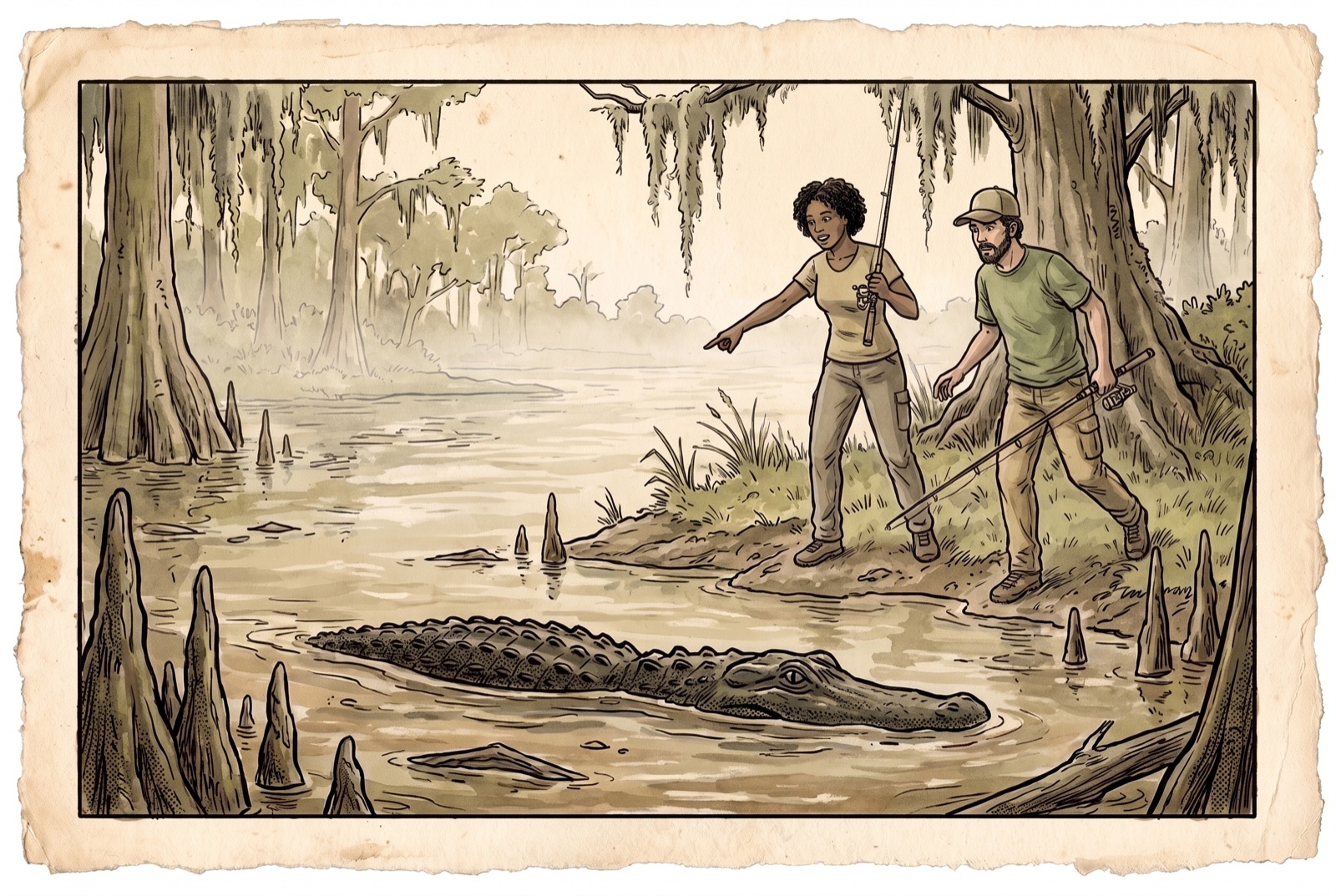
Almost every fatal crocodilian attack across the Americas in recent decades has one thing in common: a person entered, or lingered at the very edge of, water that was not a designated safe swimming area. Alligator and crocodile safety, stripped to its essentials, is a set of habits about where you put your body in relation to the water. Habits, not heroics. Learn these until they are automatic, and teach them to everyone you go out with.
The core rules
- Obey the signs. All of them. Crocodilian warning signs are not decoration and they are not there for someone else. If a sign says the area is crocodilian habitat, believe it completely. The absence of a sign does not mean safety; the presence of one means certainty.
- Only swim in designated, signposted safe swimming areas. Everything else in this chapter is secondary to this. If there is no sign clearly stating the area is safe for swimming, do not enter the water.
- Stay well back from the water’s edge. Most attacks happen at the margin. Keep at least a few yards back from any natural waterway, and never dangle your legs, wade, or crouch at the edge to wash or take a photo.
- Stand back when fishing, and never clean fish or discard scraps near the water. Fishers are over-represented in attack statistics because the sport draws them to the edge, often at dawn or dusk. Cast from well back, never stand on a low bank or log over the water, and never wade.
- Be extra careful at dawn, dusk and night. Crocodilians are most active in low light. Avoid the water’s edge entirely at these times.
- Never rely on “I’ll see it coming.” You will not. The entire hunting strategy of this animal is to be invisible until the instant of the strike.
- Don’t be predictable. If you must use a particular spot near water repeatedly, whether a boat ramp, a campsite tap or a fishing platform, vary your timing and never establish a routine that a watching crocodilian can learn.
- Keep pets and animals away from the water. Dogs splashing at the edge are both a target and a lure, and people have died trying to save a pet.
Camping and boating
- Camp at least fifty yards from the water’s edge, and further if you can. Choose sites well above the bank, away from steep drop-offs and slide marks.
- Don’t prepare food, wash dishes, or dispose of food scraps at the water’s edge. Don’t leave fish frames or bait at your campsite or boat ramp.
- Look for slide marks: smooth, flattened tracks down a bank where a crocodilian has entered or left the water. They are a clear sign of presence. So are the remains of a recent kill on the bank.
- In a boat, stay seated and keep your arms and legs inside. Don’t hang limbs over the side, don’t dangle bait by hand, and take great care at boat ramps, which are classic ambush points because crocodilians learn that fish scraps appear there.
- Don’t stand on logs or rocks overhanging the water, and be especially wary of the same few yards of bank every time you launch or retrieve a boat.
If you see a crocodilian
Back away from the water calmly and put distance between yourself and the bank. Calmly. Do not approach it for a photo, do not try to feed it, and do not assume a motionless crocodilian is asleep or harmless. If you come across a large alligator or crocodile in a populated or recreational area, report it to your state wildlife agency, in Florida the Fish and Wildlife Conservation Commission’s hotline. Feeding crocodilians, deliberately or through careless food disposal, is both illegal and lethal, because it teaches the animal to associate people with food and to lose its natural wariness.
Feeding crocodilians kills people, and crocodilians
Never feed a crocodilian, and never let one learn that humans mean food. A fed crocodilian is a future fatal attack waiting to happen. And when it happens, the animal is destroyed for it. Every person a fed crocodilian kills costs that animal its life too. Two deaths. This includes throwing fish scraps from a boat or a jetty.
Dogs: a lure, a target, and a trap for the owner
A dog is, from a crocodilian’s point of view, close to ideal prey: the right size, drawn to the water, and unable to grasp the danger. Worse, a dog splashing and swimming at the edge broadcasts exactly the irregular, struggling signal that pulls an ambush predator straight in, and many alligators seem to take dogs readily. So a dog near the water is two dangers at once: it is a target, and it is a lure that can draw a large animal into the very spot where its owner is standing. The heartbreak that follows is one of the most consistent in the whole record: people who would never have entered the water themselves plunge in without thinking to save a pet, and are killed or maimed doing it. The rule has to be firm precisely because the instinct is so strong. Keep dogs leashed and well back from any natural water’s edge; never let a dog swim, wade, or drink at a natural waterway in crocodilian country; walk them away from banks, canals and pond margins, especially at dawn and dusk. And should the worst happen and a crocodilian take your dog, do not go into the water after it. Do not. This is an agonizing thing to accept, but going in almost never saves the dog. Once a crocodilian has taken it, the dog is usually already gone, and all you do by going in after it is turn one loss into two. Your family loses the dog, and then they lose you. As much as it hurts, do not put yourself in that position.
Living on the water: yards, docks and canals
For the millions of people whose homes back onto a canal, a pond, a lake or a coastal channel, croc-wise habits have to become the ordinary furniture of daily life, because the water’s edge is now part of the property. Do not let the routine of living there erode the discipline. Keep children and pets under active supervision anywhere near the waterline, and never let either play unwatched at the bank, however tame the pond looks. Do not garden, fish, wash a boat, or crouch to work at the very edge without knowing what is in the water first, and never at dusk or after dark. Do not clean fish, dump scraps, or empty a bait bucket off your own dock; you are training the local predator to associate your home with food. Your home. Watch the seasons on your own patch: know when your water rises and connects, and treat the weeks after heavy rain as a time when a large animal may have arrived. And keep outdoor lights and a flashlight handy for the walk to a dock at night, though the better rule is simply not to be at the water’s edge after dark at all. Living beside these animals for a lifetime is entirely possible. It is done by keeping the habits sharp precisely when familiarity tempts you to let them slide.