
13 · Page 102 of 219
Fishing, Boating and the Water’s Edge
Why fishers are most at risk, and how not to be
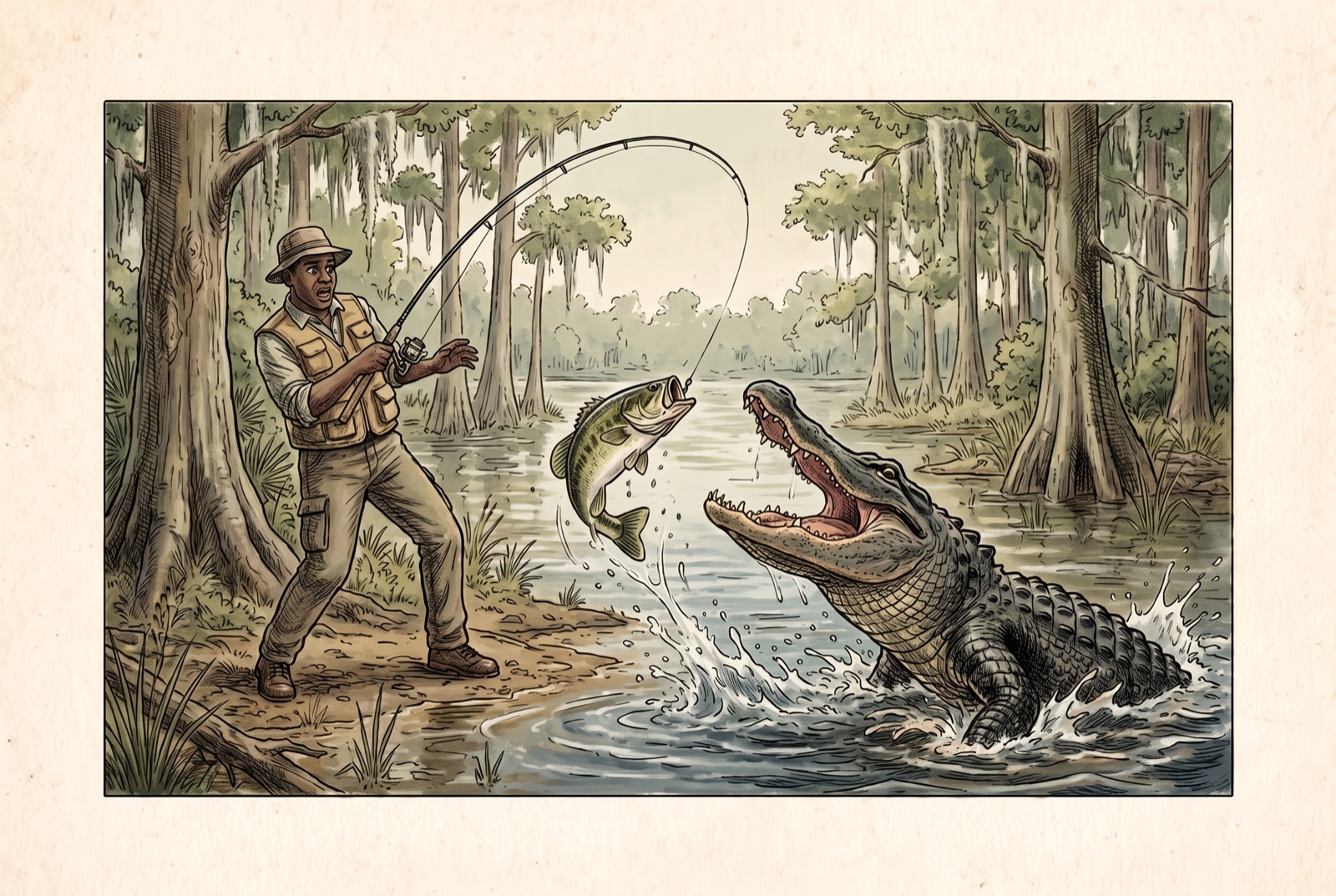
If you fish in gator or crocodile country, this chapter is for you above all others. Fishing is one of the great outdoor pastimes of the Americas. But fishers are consistently over-represented in crocodilian attacks, and the reasons are entirely about behavior, not bad luck. The sport puts a person exactly where these animals hunt: at the water’s edge, often alone, often at dawn or dusk, often standing still and focused, sometimes wading, frequently surrounded by the smell of fish and bait. A careful fisher can do everything else in life sensibly and still walk straight into the one situation a crocodilian is built to exploit.
Why fishing is uniquely dangerous
- It draws you to the edge. The whole activity happens at the margin between land and water, the precise strike zone of an ambush predator.
- It happens in the danger hours. The best fishing is often at dawn and dusk, exactly when crocodilians are most active.
- It involves bait, catch and blood. Fish, bait and the act of cleaning a catch put scent and activity into the water that can draw a crocodilian in.
- It rewards stillness and routine. Standing in the same productive spot, returning to the same bank day after day, is good fishing and terrible crocodilian safety, because it lets a watching animal learn your pattern.
- It tempts people to wade. Reaching a better cast, landing a fish, or retrieving a lure draws fishers into the water. This is where many get taken.
Fishing safely in croc country
- Stand well back from the edge, at least a few yards, and never on a low, undercut bank, a log, or a rock shelf overhanging the water.
- Never wade. Not to cast, not to land a fish, not to free a snag. No fish is worth it.
- Don’t fish the same spot at the same time repeatedly. Vary your locations and timing so no crocodilian can learn your routine.
- Never clean fish at the water’s edge, and never discard fish frames, guts or bait into or beside the water, especially at boat ramps and campsites.
- Avoid fishing alone in remote spots, and tell someone where you’ll be. Be especially careful at dawn, dusk and after dark.
- Don’t stand in the water to launch or retrieve a boat, and treat every boat ramp as a known ambush point, because crocodilians learn that ramps mean fish scraps.
- If a crocodilian takes interest in your catch or your spot, leave. Don’t compete with it, don’t try to scare it off the catch, and never try to retrieve a fish a crocodilian wants.
The moment you reel one in
There is a specific danger that catches fishers off guard, and it deserves its own warning: the act of reeling in a fish can draw an alligator or crocodile straight to you. A hooked fish thrashing on the line puts out exactly the distress signal these animals are tuned to hunt, and it is not unusual for one to follow that fish in toward the bank or boat, sometimes right behind the fish you are about to lift from the water. None of this means quit fishing. Fishing is one of the best things there is, and I am not going to tell you to give it up. But be honest about what you are doing in that moment. You are dragging a struggling, flashing animal across the surface, and a crocodilian can feel it and see it from a long way off. This is not rare. On the great rivers of Africa it is almost routine to watch a Nile crocodile rise out of nowhere and snatch a hooked fish off the line before the fisher can swing it clear. Same instinct, same animal, wherever you are. So bring the fish up fast, keep your eyes on the water the whole way, and take special care in that last moment as you lift it into the boat or up the bank.
As you land a fish, be acutely aware of where your body is, your hands, your arms, your face, and never reach down toward the water to grab a fish or a line without knowing exactly what is beneath the surface. Think of it this way: when you are reeling a fish in, you may as well be reeling in the crocodile too. It can erupt from the murky bottom right where you are reaching, after the fish, and take your hand, your arm, or more along with it. Which is why leaning down over the water to lift a fish off the line is such a dangerous habit in crocodilian country. Do not do it. Bring the fish up and into the boat as fast as you can, keeping your body back and over solid ground or the deck, never out over the surface. And if you cannot land it without leaning out over the water, cut the line. A lure or a fish is never, ever worth your life. The same goes for any crocodilian that takes an interest in your catch: let it have the fish. You can always catch another fish. You cannot catch another hand, and you cannot catch another life.
This is not a hypothetical. In late June 2026, an eleven-year-old boy named Brodie Terry, visiting central Florida from Pennsylvania, was fishing from the bank of a fish camp near Umatilla with his family. He had just caught a fish and crouched at the water’s edge to release it when an alligator surged out and seized his arm. His father went into the water after him, threw himself onto the animal and fought to force its jaws apart. The gator rolled anyway, and the roll took the boy’s hand. Surgeons operated on it several times before amputating at the wrist. He lived. Wildlife officers later found and removed the alligator, which measured eight feet seven inches.
His story is this entire warning in a single, terrible moment. The danger was not out where the fish had been hooked; it was in the last few feet of bank, where a caught fish, the splash of releasing it, and a child’s hands all came together right at the surface, exactly the place, and exactly the instant, a large alligator lies in wait for. It is why you keep your body back and over solid ground whenever you land or release a fish, why you never lower your hands to the waterline in alligator country, and why children should be kept well away from the edge entirely. An attack does not have to end in death to change a life forever.
In the boat
A boat feels safe, and mostly it is. But alligators and crocodiles have lunged at and even climbed onto small boats, and people have been taken while leaning out or trailing limbs. Stay seated and keep your arms and legs inside the boat. Don’t dangle bait by hand over the side, don’t hang a catch on a stringer in the water beside the boat, and don’t lean out to land or release fish. Take particular care in small, low craft and around launching and retrieving, when you are closest to the bank and most distracted.
The fisher’s creed
Stay back. Don’t wade. Don’t clean fish at the water. Don’t be predictable. No bass, no bream, no catch of any kind is worth your life.
Why splashing and banging the boat backfires
Because a crocodilian feels the water with its whole body, noise and disturbance do not frighten it. They inform it. Those fingertip-sensitive pressure receptors read every vibration: a struggling fish, a wading leg, a slapped surface, a knocked hull. To a hunting crocodilian, that thrashing signal means one thing, and it is not danger. It is food.
This is why one common piece of folk wisdom is lethally backwards. In parts of Africa and elsewhere, some fishers bang the side of the boat or slap the water in the belief that it scares crocodilians off. It does the opposite. Banging and splashing broadcast exactly the signal a crocodilian is tuned to hunt, the struggle of something alive and in trouble, and can draw an animal in from a distance rather than send it away. The animal knew you were there long before you sensed it; announcing yourself with vibration only rings the dinner bell. Near croc water, be still and quiet at the edge: don’t trail hands or feet, don’t slap or splash, don’t clean fish or dangle a catch over the side, and never mistake making noise for making yourself safe.