14 · Page 111 of 219
Emergencies and First Response
What to do when seconds matter
Why this chapter exists
People ask us this constantly. After talks, in messages, at the shop, from the back of a boat: what do I do if one gets hold of me. So we answer it. Refusing to answer has never made anybody safer.
What follows is what we would do. Nothing more. It is not a procedure, and we are not handing you instructions to carry out. Read it as an answer to a question, given by people who have spent their working lives around these animals and have been asked it more times than we can count.
Understand where you are by the time any of it applies. If this chapter is relevant to your day, prevention already failed. The rest of this book is the part that keeps you alive. This is what is left after that part didn't.
And none of it is guaranteed. People have survived doing these things, and people have died doing exactly the same things, in water that looked the same, against animals the same size. We can tell you what we would try. We cannot tell you that it works.
One more thing, and we mean it: if anything here ever conflicts with what a dispatcher, a paramedic or a doctor is telling you in the moment, do what they say. They can see the situation. A book cannot.
The entire philosophy of this book is prevention, because once a crocodilian has a grip the outcome is largely out of human hands. But it would be irresponsible not to cover what to do in an emergency: if you witness an attack, if someone is bitten, or if you find yourself in serious danger near the water. So here it is. Knowing this will not make a risky choice safe, but it can save a life in the rare moment it is needed.
If you see a crocodilian near people
- Move everyone calmly away from the water and well back from the bank. Don’t approach the animal, don’t provoke it, and don’t try to photograph it from close range.
- Warn others in the area. Tell other swimmers, fishers and campers immediately.
- Report it. Contact your state wildlife agency to report an alligator or crocodile in or near a populated or recreational area. Officers assess and, where necessary, relocate an animal that has wandered somewhere it cannot safely stay.
If someone is attacked
Crocodilian attacks are sudden and violent, and the instinct to help is powerful. Overwhelming, actually. But rescuers have themselves been killed entering the water. Your first duty is not to become a second victim.
There is a hard version of this that has to be said plainly. Sometimes you will be the one giving the warning, telling people there is a crocodilian in that water and to get back, and some of them will laugh it off. Reason with them once. Maybe twice. After that, if a grown adult has been told clearly that there is a large predator in the water and gets in anyway, you have to let it go. Call it natural selection, because that is what it is. What you never do is follow them in. Jumping in after someone who ignored the warning does not save them. The animal’s whole instinct is to drag its prey into deep water, drown it, and roll. All you do by going in is feed the same water a second person. Help from the bank or a boat, with anything you can reach or throw. Never with your body.
- Call your local emergency number immediately. In the United States and Mexico that number is 911; elsewhere in the Americas, know the local emergency number before you need it, and dial it for police, fire and ambulance.
- Do not enter the water after the victim if a crocodilian is active. More than one person has died attempting a rescue. Help from solid ground or a boat wherever possible.
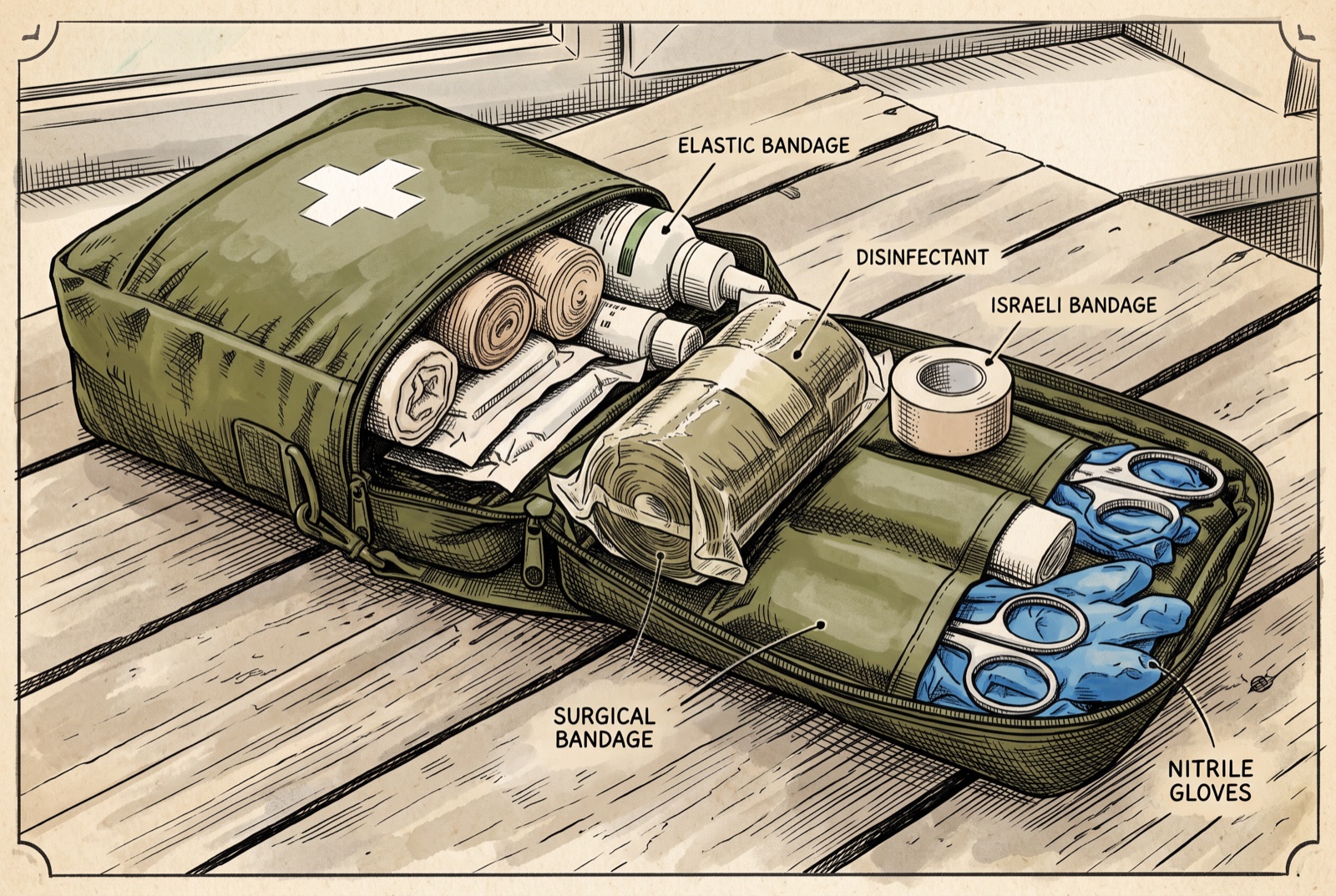
- Once the person is clear of the water, bleeding is what we would go at first. Crocodilian bites cause massive wounds. We would put firm, direct pressure on it, and use a tourniquet above a severe limb wound if one was to hand and somebody there knew how, noting the time it went on.
- We would keep the person warm, still and reassured, and treat for shock while waiting for help.
- Assume wounds are heavily contaminated. Crocodilian bites carry a very high risk of serious infection, so all but the most trivial bites need urgent professional medical care even if bleeding is controlled.
If a crocodilian approaches you on land or in shallow water
This is a situation you should never be in if you follow the rest of this book. But if a crocodilian is moving toward you on a bank or in shallows, move away from the water as quickly as you can in a direct line. Straight line. Do not run in zig-zags; that is a myth and it wastes time. Put solid distance and, if possible, a barrier between yourself and the animal. If you are camping and a crocodilian has been seen, move your camp well back from the water without delay.
Keep these numbers
Emergency (police, fire, ambulance): 911 in the United States and Mexico; know your local emergency number wherever you are in the Americas.
Alligator or crocodile sightings in populated or recreational areas: report to your state wildlife agency, and in Florida to the Fish and Wildlife Conservation Commission’s nuisance-alligator hotline.
The best first aid is prevention: the surest way to survive a crocodilian attack is to never be in a position to have one.
If it has hold of you, or of someone else
Be honest here, because false hope gets people killed. Once a crocodilian has you in its jaws the situation is grave, and you must understand why: those conical teeth are built to grip and hold, and the animal’s instinct is to drag you into deeper water and roll. You will not pull free by strength. And trying to haul a victim straight back out of the jaws can deepen the wounds, because the teeth are shaped to hold against exactly that pull. Dragging against the grip tears; it does not release.
If we were seized, or fighting for someone who was, we would forget the body and go for the eyes. The eyes, specifically. They are a reliably vulnerable spot on the animal, and hard, determined gouging or striking at them is the best chance, never a guarantee, of making it let go. If we could not reach the eyes, we would jam something into the mouth: a stick, a paddle, an arm if it came to that, anything that fouls the bite. We would fight with everything we had. Crocodilians do sometimes release prey that proves too difficult, and sometimes they do not. And the instant you are free, get to land, the water is where it wins, press hard on any bleeding, and get emergency help immediately, because these bites cause massive blood loss and near-certain infection.
The bleeding, in order: what to do the moment someone is out of the water
Once a bitten person is clear of the water, the thing most likely to kill them in the next few minutes is blood loss, so that is what we would go at first, before anything else, before worrying about the wound itself. Crocodilian bites tear rather than slice, and they can open major blood vessels; a person can bleed to death from a limb wound faster than an ambulance can arrive. We would press hard and directly on the bleeding with whatever was there: a folded shirt, a towel, hands over cloth. And not ease off to look. Not once. If a limb was bleeding catastrophically and direct pressure was not controlling it, and there was a tourniquet and somebody who knew how to use one, we would put it on high and tight above the wound, note the time, and not loosen it; a windlass improvised from a belt or strap and a sturdy stick can serve if there is nothing better. We would keep the person lying down, warm, and as still and calm as we could, because shock is a real and fast danger after a wound like this. Do not give them anything to eat or drink; serious wounds often need surgery. We would keep talking to them, keep the pressure on, and keep help coming.
After the bleeding is controlled: the wound and the days that follow
Every crocodilian bite that breaks the skin needs professional medical care, even a small one, and the reason is infection. A crocodilian’s mouth and the water it lives in are thick with bacteria, including aggressive organisms such as Aeromonas from fresh water and Vibrio species from brackish and salt water, and these wounds become infected at a very high rate, sometimes with fast-moving, limb- and life-threatening infections that appear a day or two after the bite looks stable. This is why a bite that seems minor must never be shrugged off: the danger arrives later. Days later, sometimes. At the hospital these injuries are cleaned out thoroughly, left open or only loosely closed rather than sealed up, and treated with broad-spectrum antibiotics and an up-to-date tetanus shot. Until you can reach care, cover the wound with a clean dressing and keep it as clean as you can, but do not scrub it or pour anything into a deep wound in the field. If a body part has been amputated, bring it if you safely can: wrap it in clean, damp gauze, seal it in a bag, and keep the bag cool on ice, never letting the tissue sit directly against the ice. Watch, over the hours and days that follow, for spreading redness, swelling, heat, pus, red streaks, or fever, and treat any of them as an emergency in its own right. The bite is the first crisis; the infection is the second, and it is the one people underestimate.